A refrigerator that is not cooling properly can turn into a bigger problem surprisingly fast. Food gets warmer, condensation may appear, the freezer may start struggling, and the appliance can run almost continuously without getting cold enough.
The good news is that a refrigerator not cooling does not automatically mean the compressor has failed.
A wrong temperature setting, blocked air vent, dirty condenser coil, damaged door gasket, failed fan, frost buildup, defective thermostat, or defrost problem can all affect cooling. Some problems are simple enough to check at home. Others require proper diagnosis before replacing any parts.
The first question is how the refrigerator is behaving. Is the freezer still cold? Is the entire refrigerator warm? Is the compressor running? Do you hear a fan? Is there heavy frost on the freezer’s back wall?
Those details can narrow the problem considerably.
For food safety, the refrigerator should maintain 40°F or below, while the freezer should be 0°F. An appliance thermometer is more reliable than guessing based on how the food or shelves feel.
Why Is My Refrigerator Not Cooling?
The most common causes include:
- Incorrect temperature settings
- Blocked interior air vents
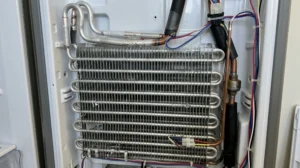
- Dirty condenser coils
- A faulty evaporator fan
- A failed condenser fan
- Frost blocking the evaporator
- A defective defrost system
- A damaged door gasket
- A faulty thermostat or temperature sensor
- A compressor or start relay problem
- A refrigerant leak or sealed system problem
- A control board failure
The important point is that these failures do not all produce the same symptoms.
A refrigerator that is warm while the freezer remains cold points toward a different problem than a refrigerator where both sections are warm and the compressor never starts.
First, Check the Actual Temperature
Before taking anything apart, measure the temperature.
Set a refrigerator thermometer inside the fresh food section and leave it in place long enough to get a meaningful reading. Many electronic controls display a target setting rather than the actual temperature inside the cabinet.
The FDA recommends keeping a refrigerator at 40°F or below and a freezer at 0°F.
This matters because a refrigerator can feel cold while still being too warm for safe food storage.
For example, if the refrigerator is holding at 45°F, it may seem reasonably cool when you open the door. The problem is that it is not maintaining the recommended storage temperature.
Check the Temperature Setting
Start with the easiest possible cause.
Someone may have accidentally changed the refrigerator setting. This can happen when food is moved around, a control is bumped, or a smart appliance receives a setting change.
Check both the refrigerator and freezer controls according to the manufacturer’s instructions.
Do not immediately turn the refrigerator to its coldest setting and assume that will solve the problem. If an appliance has an underlying cooling fault, lowering the setting may simply make the compressor run longer without addressing the actual failure.
After adjusting the control, give the refrigerator enough time to stabilize and check the temperature again.
Make Sure Air Can Move Through the Refrigerator
Cold air has to circulate.
Many refrigerators produce cold air in the freezer and then move that air into the fresh food compartment. If food containers, packages, or ice are covering the vents, the refrigerator section may become warm even though the freezer still feels cold.
Look for vents at the rear or sides of the refrigerator compartment and freezer.
Do not pack food tightly against them.
A completely packed refrigerator can also restrict airflow. The FDA specifically recommends avoiding overpacking because cold air needs room to circulate around stored food.
This is one of the easiest things to correct and one of the easiest things to overlook.
Why Is the Freezer Cold but the Refrigerator Warm?
This is one of the most common refrigerator troubleshooting questions.
When the freezer remains cold but the refrigerator compartment is warm, the cooling system may still be producing cold air, but that air is not reaching the fresh food section properly.
Potential causes include:
Blocked air vents
Food or ice may be preventing cold air from moving into the refrigerator compartment.
Evaporator fan failure
The evaporator fan circulates cold air across the evaporator coil and through the refrigerator. If the fan stops working, the freezer may still have some cooling while the refrigerator compartment becomes increasingly warm.
Frost buildup
A thick layer of frost can cover the evaporator coil and restrict airflow.
Damper problem
Some models use a damper assembly to control how much cold air enters the refrigerator section. If the damper becomes stuck or fails, airflow can be reduced.
Defrost system failure
A refrigerator with an automatic defrost system should periodically remove frost from the evaporator coil. If the defrost heater, defrost thermostat, sensor, timer, or control system fails, frost can gradually build until normal airflow is restricted.
This particular combination of symptoms is useful because it tells you the refrigerator may not have a complete cooling system failure.
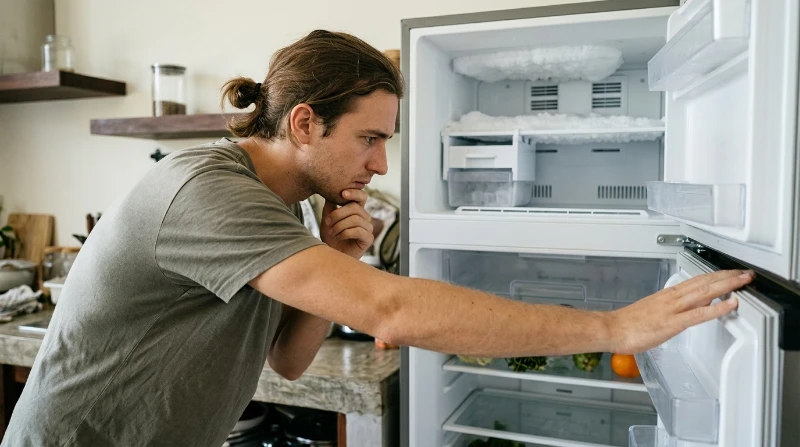
Look for Heavy Frost on the Freezer Back Wall
Open the freezer and inspect the rear interior panel.
A light amount of frost can be normal on some appliances. Heavy, widespread frost or a thick layer of ice is a different story.
If the evaporator coil becomes heavily iced over, air movement can drop significantly. The freezer may still appear cold while the fresh food compartment slowly warms.
A common mistake is to assume that the visible ice is the original problem.
It may actually be the result of a defrost system failure.
The evaporator coil becomes cold during normal operation. The defrost system periodically removes the frost that forms on it. When that process fails, the ice continues building until it interferes with airflow.
That means simply removing the ice may provide temporary improvement without repairing the underlying problem.
Should You Unplug a Refrigerator to Defrost It?
Manual defrosting can sometimes temporarily restore airflow when ice is blocking the evaporator, but it should not be treated as a complete repair.
Before doing anything, protect the food and follow the manufacturer’s instructions.
Never use a sharp object to chip ice from an evaporator area. Refrigerator components, tubing, wiring, and insulation can be damaged easily.
Do not use aggressive heat directly against plastic components or internal refrigerator parts.
The bigger question is why the ice formed in the first place.
If the evaporator frosts up again after the refrigerator is returned to operation, the appliance needs further diagnosis. The fault could involve the defrost heater, thermostat, thermistor, control system, wiring, or another component.
Clean the Condenser Coils
Condenser coils release heat from the refrigeration system.
When those coils become heavily coated with dust, pet hair, or debris, heat transfer can become less effective. The compressor may then work harder and run longer.
The exact location varies by refrigerator design. The coils may be underneath the cabinet, behind it, or integrated into another part of the appliance.
Before cleaning anything, disconnect power and follow the manufacturer’s cleaning instructions.
Use a suitable refrigerator coil brush or vacuum attachment where appropriate.
Do not bend delicate components or force debris deeper into the cabinet.
Cleaning the coils can help when dirt is genuinely restricting heat transfer. It will not repair a failed compressor, broken fan motor, refrigerant leak, or defective control board.
That distinction is important because replacing parts based only on a dirty-coil suspicion can waste money.
Check the Condenser Fan
Some refrigerators use a condenser fan to move air over the condenser area and help dissipate heat.
If the fan is not operating correctly, the refrigerator may have difficulty maintaining the desired temperature.
Depending on the design, you may notice:
- The refrigerator running for unusually long periods.
- Excessive heat around the lower rear area.
- Unusual buzzing or grinding.
- Little or no airflow where the condenser fan should move air.
Do not assume a fan motor is defective simply because you cannot immediately hear it.
Fan operation can depend on the refrigerator’s operating cycle and model design.
A technician can check whether the fan is receiving power and whether the motor is actually failing.
Check the Refrigerator Door Seal
The door gasket is easy to ignore because it looks like a simple strip of rubber.
It is actually an important part of the refrigeration system.
If the gasket is torn, warped, dirty, or no longer making proper contact with the cabinet, warm room air can continuously enter the refrigerator.
That creates additional moisture and increases the cooling load.
Check the entire gasket rather than only the corner that looks damaged.
Look for:
- Tears
- Cracks
- Gaps
- Flattened sections
- Dirt or food residue
- Areas where the gasket pulls away from the cabinet
Also check whether something inside the refrigerator is preventing the door from closing completely.
A refrigerator can have a perfectly functioning compressor and still struggle to maintain temperature because the door is not sealing.
What Does It Mean When the Refrigerator Runs Constantly?
A refrigerator that runs continuously is telling you something useful.
It does not necessarily mean the compressor itself has failed.
The appliance may be running longer because it cannot remove enough heat from the cabinet or cannot maintain the selected temperature.
Possible reasons include:
- Dirty condenser coils
- Poor door sealing
- Heavy frost buildup
- Poor airflow
- A failing condenser fan
- A failing evaporator fan
- Incorrect temperature control
- A refrigerant or sealed system problem
- Compressor inefficiency
Compare this symptom with the actual temperature.
If the refrigerator runs almost constantly but remains too warm, the system is likely unable to reach its target temperature.
If it runs normally and maintains temperature, the long runtime may be related to environmental or usage conditions.
What If the Refrigerator Is Not Cooling but You Hear Clicking?
Clicking sounds can occur for several reasons, and the sound itself is not enough to identify a failed part.
Repeated clicking followed by the refrigerator not starting can point toward a starting or compressor-related problem.
A failed start relay can prevent a compressor from starting correctly.
Some modern refrigerators also have electronic controls and inverter compressors, which can behave differently from older conventional compressor systems.
That is why listening for the sound is useful, but diagnosing the exact component requires electrical and system testing.
If the refrigerator repeatedly clicks, attempts to start, and then stops cooling, professional diagnosis is usually the better choice than replacing parts based on the sound alone.
What If the Refrigerator Is Completely Warm?
When both the freezer and refrigerator compartments are warming, the problem may be more serious.
Start with the basics.
Check the electrical connection and make sure the appliance is receiving power.
Check whether interior lights or the control display are working.
Confirm that the temperature controls have not been turned off.
Then listen for normal operating sounds.
If the refrigerator has power but is not producing cold air in either compartment, possible causes include a compressor problem, start relay failure, control issue, condenser or evaporator fan failure, sealed system problem, or another refrigeration fault.
At this stage, random part replacement becomes especially risky.
Could Low Refrigerant Cause a Refrigerator Not to Cool?
Yes, a sealed system problem or refrigerant leak can cause poor cooling.
But refrigerator refrigerant does not normally disappear simply because the appliance is old.
If refrigerant is low, there is usually a reason.
A leak or sealed system failure should be investigated rather than simply adding refrigerant and sending the appliance back into service.
Refrigeration work involving refrigerants should be handled by appropriately certified personnel. The EPA requires technicians who service equipment covered by Section 608 to obtain the appropriate certification, including work involving refrigerants.
A refrigerator with a suspected sealed system problem can require specialized tools and measurements that are not part of normal homeowner troubleshooting.
What Does a Bad Compressor Look Like?
The compressor is responsible for circulating refrigerant through the sealed system.
A compressor-related problem can produce several symptoms.
The compressor may fail to start.
It may start and run but fail to provide adequate cooling.
It may become unusually hot.
It may repeatedly attempt to start.
Or another component may prevent the compressor from operating properly even though the compressor itself is not the problem.
This is why a compressor should not be condemned simply because a refrigerator is warm.
A proper diagnosis checks the surrounding components and operating conditions before recommending an expensive compressor replacement.
Refrigerator Not Cooling After a Power Outage
A refrigerator can take time to return to its normal temperature after a power interruption, particularly if the doors were opened frequently.
Keep the refrigerator and freezer doors closed as much as possible.
The FDA states that an unopened refrigerator can generally keep food cold for about four hours during a power outage.
Food safety becomes more important than troubleshooting when the temperature has risen significantly.
The USDA recommends maintaining the refrigerator at 40°F or below. Perishable food that has been above 40°F for more than two hours should be discarded under its guidance.
When the outage has ended, check the actual appliance temperature rather than assuming the refrigerator has recovered.
Refrigerator Not Cooling in Austin, TX? Heat Can Expose Existing Problems
A refrigerator operates by removing heat from the cabinet and releasing it through the condenser system.
When an appliance is already struggling because of restricted airflow, dirty condenser coils, a weak fan, poor ventilation, or another mechanical problem, higher surrounding temperatures can make the weakness more noticeable.
That does not mean every warm refrigerator in Austin has a climate-related cause.
The useful diagnostic question is whether the appliance maintains its normal temperature under the conditions where it is installed.
A refrigerator placed in a poorly ventilated location, directly against a wall, or in a space with inadequate clearance may have a harder time rejecting heat.
Always check the installation and clearance requirements in the manufacturer’s documentation.
Common Refrigerator Cooling Problems and What They May Indicate
| Symptom | Possible Cause | First Thing to Check |
| Freezer cold, refrigerator warm | Airflow, evaporator fan, frost, damper | Check vents and frost |
| Both sections warm | Compressor, controls, fans, sealed system | Check power and operating sounds |
| Heavy freezer frost | Defrost problem | Inspect frost pattern |
| Refrigerator runs constantly | Dirty coils, airflow, gasket, cooling-system fault | Check temperature and condenser area |
| Clicking but no cooling | Start relay, compressor, controls | Listen for repeated start attempts |
| Warm air entering around door | Damaged gasket or obstruction | Inspect door seal |
| Poor cooling with dirty coils | Restricted heat transfer | Clean according to manufacturer guidance |
| Cooling comes and goes | Sensor, control, fan, frost, compressor issue | Monitor temperature and operating cycle |
The table is a starting point, not a substitute for diagnosis. Several refrigerator problems produce similar symptoms.
What You Can Safely Check Yourself
Before calling a refrigerator repair technician, you can usually perform a few basic checks.
1. Measure the temperature
Use an appliance thermometer rather than your hand.
2. Check the settings
Make sure the controls are set correctly and the refrigerator has not been placed in an unusual mode.
3. Check the vents
Move food away from interior vents and make sure airflow is not blocked.
4. Inspect the door gasket
Look for visible damage, gaps, or anything preventing the door from closing.
5. Look for excessive frost
Heavy frost on the freezer’s rear panel can point toward an airflow or defrost problem.
6. Inspect the condenser area
If accessible and permitted by the manufacturer’s instructions, check for obvious dust buildup.
7. Listen to the appliance
Notice whether you hear normal fan operation, repeated clicking, unusual buzzing, or grinding.
These observations can give a repair technician useful information and can prevent unnecessary guesswork.
What You Should Not Try to Repair Yourself
Some refrigerator problems require specialized tools and electrical or refrigeration knowledge.
Avoid attempting to:
- Add refrigerant yourself.
- Open the sealed refrigeration system.
- Cut refrigerant lines.
- Bypass electrical safety devices.
- Force a compressor to start.
- Replace control components without proper testing.
- Use sharp tools to remove evaporator ice.
- Disassemble electrical components while the appliance is energized.
A refrigerator contains electrical components, moving parts, and a sealed refrigeration circuit.
Improper repairs can turn a relatively straightforward fault into a more expensive repair.
Common Mistakes People Make When a Refrigerator Stops Cooling
Turning the thermostat colder
Changing the setting does not fix a failed fan, blocked evaporator, defective sensor, or compressor problem.
Replacing the compressor immediately
The compressor is expensive and may not be the failed component.
Defrosting the refrigerator and stopping there
Manual defrosting can temporarily restore airflow, but recurring ice buildup usually needs a root cause diagnosis.
Ignoring the door gasket
A small seal problem can allow warm air to enter continuously.
Judging temperature by touch
Cold shelves do not tell you whether the refrigerator is maintaining 40°F or below.
Repeatedly resetting the appliance
A reset can occasionally clear an electronic fault, but repeatedly cycling power will not repair a failed physical component.
When Should You Call a Refrigerator Repair Technician?
Call for professional refrigerator repair when:
- The refrigerator remains above 40°F despite basic checks.
- The freezer and refrigerator are both warm.
- The compressor is clicking or repeatedly trying to start.
- The appliance has heavy recurring frost.
- Fans are not operating correctly.
- The refrigerator runs constantly without reaching temperature.
- You suspect a refrigerant leak or sealed system problem.
- There is a burning smell, damaged wiring, or another electrical concern.
- The problem returns after a temporary fix.
- The refrigerator contains expensive or time-sensitive food that cannot safely remain warm.
The biggest advantage of professional service is not simply replacing a part.
It is finding the actual reason the refrigerator stopped cooling.
A technician can evaluate airflow, electrical components, temperature sensors, fan motors, defrost components, compressor operation, and sealed system performance before recommending a repair.
Repair or Replace Your Refrigerator?
A refrigerator should not automatically be replaced because it has stopped cooling.
The better decision depends on several factors:
- Appliance age
- Overall condition
- Repair cost
- Availability of replacement parts
- Energy efficiency
- Compressor or sealed system condition
- History of previous repairs
- Warranty coverage
A refrigerator with a failed door gasket or fan motor may be worth repairing.
An older refrigerator with a major sealed system or compressor failure may deserve a closer replacement comparison.
Ask for a clear diagnosis and written estimate before approving major work.
The goal is not simply to make the refrigerator cold again for one week. The goal is to determine whether the appliance can provide reliable service at a reasonable cost.
Questions to Ask an Austin Refrigerator Repair Technician
Before scheduling service in Austin, ask a few practical questions.
Do you repair my refrigerator brand and model?
Major brands can use very different components and control systems.
Do you diagnose the problem before replacing parts?
A proper diagnosis should come before an expensive component replacement.
Is there a diagnostic fee?
Some companies charge a service or diagnostic fee, while others apply it toward approved repairs. Get the terms before the appointment.
What warranty comes with the repair?
Ask whether the warranty covers labor, parts, or both.
Do you handle sealed system and refrigerant problems?
Not every appliance repair provider handles refrigeration work in the same way.
Can you provide the repair estimate before starting?
A clear estimate makes it easier to decide whether repairing or replacing the appliance makes financial sense.
How to Protect Food While the Refrigerator Is Not Cooling
When the cooling system fails, food safety becomes the priority.
Keep the doors closed as much as possible.
Use a refrigerator thermometer to determine the actual temperature.
The FDA recommends keeping refrigerated food at 40°F or below.
Do not rely on smell or appearance alone when deciding whether questionable food is safe. Harmful bacteria may not change the smell or appearance of food.
During an extended failure, transfer sensitive food to a working refrigerator or properly cooled storage as soon as possible.
When temperatures have exceeded safe limits for too long, discarding food is safer than taking a chance.
Frequently Asked Questions About a Refrigerator Not Cooling
1: Why is my refrigerator not cooling but the freezer is cold?
The freezer may still be producing cold air, but airflow into the refrigerator compartment can be restricted. Common possibilities include blocked vents, evaporator fan problems, frost buildup, or a damper issue.
2: Why is my refrigerator running but not getting cold?
A refrigerator can run continuously when it is struggling to remove enough heat. Dirty condenser coils, poor airflow, frost buildup, fan problems, door seal issues, and sealed system faults can all contribute.
3: Can dirty coils make a refrigerator stop cooling?
Yes. Heavy debris on condenser coils can interfere with heat transfer and make the refrigeration system work harder. Cleaning may help when dirt is the actual cause, but it will not fix a mechanical or sealed system failure.
4: How do I know if my refrigerator needs refrigerant?
Poor cooling alone does not prove that refrigerant is low. A sealed refrigeration system should be properly diagnosed for leaks or other faults before refrigerant is added. Refrigerant service should be handled by appropriately certified technicians.
5: Why does my refrigerator have ice buildup but still not cool?
Heavy frost can cover the evaporator coil and restrict airflow. A failed defrost heater, sensor, thermostat, timer, or control component can allow that frost to accumulate.
6: What temperature should a refrigerator be?
The FDA and USDA recommend maintaining a refrigerator at 40°F or below. The freezer should be around 0°F.
7: How long does it take for a refrigerator to get cold again?
Recovery time depends on the model, starting temperature, room conditions, door openings, food load, and the cause of the problem. A refrigerator that has an actual mechanical failure may never return to a safe temperature without repair.
8: Should I unplug my refrigerator if it is not cooling?
Not necessarily. Unplugging may be appropriate during certain troubleshooting steps or when instructed by the manufacturer, but repeatedly disconnecting the appliance will not solve a mechanical failure. Keep the doors closed and protect the food while determining the cause.
9: Is it worth repairing an old refrigerator?
It depends on the refrigerator’s age, condition, repair cost, energy use, parts availability, and the severity of the failure. A relatively simple repair can make sense even on an older appliance, while a major sealed system repair may justify comparing replacement options.
Conclusion
When a refrigerator is not cooling, start with information instead of parts.
Measure the temperature. Check the settings. Make sure air can move through the cabinet. Inspect the door seal and look for unusual frost. Listen for fans, clicking, or other changes in normal operation.
Those simple observations can tell you a lot.
If the refrigerator remains warm, repeatedly clicks, develops heavy frost, runs constantly without reaching temperature, or shows signs of a fan, compressor, electrical, or sealed system problem, professional refrigerator repair is the safer next step.
For Austin homeowners, getting an accurate diagnosis matters more than guessing which part failed. A good technician should explain what caused the cooling problem, what repair is required, what it will cost, and whether repairing the existing refrigerator makes sense compared with replacement.