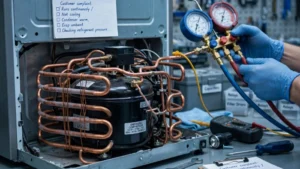
Refrigerator Compressor Running but Not Cooling: Causes and Fixes
If your refrigerator compressor is running but the refrigerator is not getting cold, the compressor itself may not be the problem.
That distinction matters.
A running compressor tells you that at least part of the cooling system is operating. It does not prove that refrigerant is circulating correctly, that the evaporator is getting cold, that air is moving through the refrigerator, or that the defrost system is working.
The actual problem could be a blocked evaporator coil, failed evaporator fan, dirty condenser, condenser fan issue, refrigerant leak, airflow restriction, defrost failure, temperature sensor problem, control board fault, or an inefficient compressor.
The symptoms around the compressor are what narrow the diagnosis.
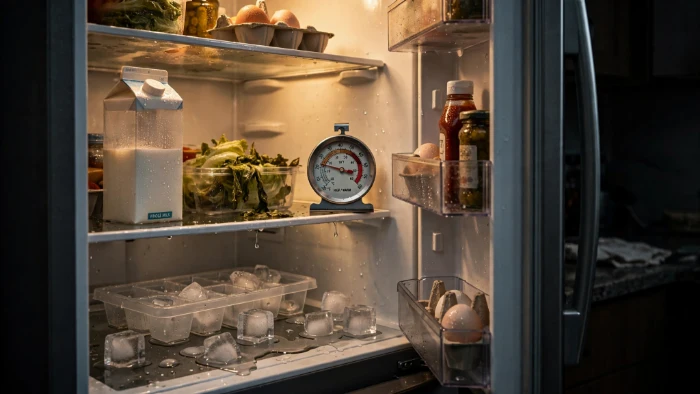
Before troubleshooting, check the actual temperature with an appliance thermometer. The FDA recommends keeping a refrigerator at 40°F or below and a freezer at 0°F or below. A refrigerator that feels slightly cool is not necessarily operating at a safe temperature.
Why Is My Refrigerator Compressor Running but Not Cooling?
The most common causes include:
- Frost has blocked the evaporator coil or airflow.
- The evaporator fan is not moving cold air.
- The condenser coils are heavily dirty.
- The condenser fan is not operating correctly.
- The refrigerator has a refrigerant or sealed system problem.
- A door gasket is allowing too much warm air into the cabinet.
- Air vents are blocked.
- A temperature sensor or control system is providing incorrect information.
- The compressor is running but is no longer pumping refrigerant efficiently.
- Another component is interfering with the normal refrigeration cycle.
The important clue is this:
A compressor that runs continuously while the refrigerator stays warm is not automatically proof of compressor failure.
A refrigerator has several components that must work together. The compressor circulates refrigerant, the condenser releases heat, the evaporator absorbs heat, fans move air, and electronic controls manage when those components operate.
A problem anywhere in that chain can reduce cooling.
What Does the Compressor Actually Do?
The compressor is the driving force behind the refrigeration cycle.
It compresses refrigerant and circulates it through the sealed system. As the refrigerant moves through the condenser and evaporator, heat is transferred out of the refrigerator compartments.
The compressor therefore needs help from the rest of the system.
If the evaporator cannot absorb heat properly, if the condenser cannot release heat, if a fan cannot move air, or if the sealed system has lost refrigerant, the refrigerator can remain warm even while the compressor continues running.
LG explains that the compressor creates the cooling process by compressing and circulating refrigerant, while fans help move or release heat as part of normal operation.
That is why listening to the compressor is useful, but not enough to diagnose the appliance.
The First Question: Is the Freezer Cold?
Before removing panels or testing components, check both compartments.
There are two very different situations.
The freezer is cold but the refrigerator is warm
This often points toward an airflow problem.
Possible causes include:
- Evaporator fan failure
- Blocked vents
- Frost buildup
- Damper problems
- Air circulation restrictions
- Sensor or control problems
In many refrigerator designs, cold air is created around the evaporator and then distributed through the freezer and fresh food sections.
If the freezer remains cold but the refrigerator warms up, the cooling system may still be producing cold air. The issue may be getting that air where it needs to go.
Both the freezer and refrigerator are warm
The diagnostic picture changes.
Possible causes include:
- Poor condenser heat transfer
- Condenser fan failure
- Refrigerant leak
- Sealed system restriction
- Compressor inefficiency
- Control problem
- Severe frost restriction
- Other refrigeration system failures
This distinction can save a lot of unnecessary part replacement.
A Compressor Running Constantly Is Not Always a Bad Sign
A refrigerator may run for long periods under normal conditions.
Opening the doors frequently, adding a large amount of warm food, hot ambient conditions, and a refrigerator that has recently been installed can all increase compressor runtime.
LG notes that operating time can increase when the refrigerator is recently installed, when doors remain open, when large amounts of food are added, or when surrounding temperatures are higher.
The concern is different when the compressor keeps running while the cabinet temperature remains too high.
That suggests the appliance is trying to cool but cannot reach its target.
At that point, the question becomes why.
Check the Temperature Before Diagnosing the Compressor
Do not rely on your hand.
A shelf that feels cool does not tell you whether the refrigerator is maintaining a safe temperature.
Place an appliance thermometer inside and allow the reading to stabilize.
The FDA recommends keeping the refrigerator at or below 40°F and the freezer at 0°F or below. It also recommends using appliance thermometers because refrigerator controls do not always display the actual internal temperature.
Temperature measurements can also help a technician understand the severity of the problem.
For example:
Refrigerator at 45°F and compressor running continuously gives a very different diagnostic picture from refrigerator at 39°F with longer than usual operating cycles.
The first suggests a cooling problem.
The second may be normal under certain conditions.
Dirty Condenser Coils Can Make a Refrigerator Run Without Cooling Properly
Condenser coils release heat removed from the refrigerator.
When those coils become heavily coated with dust, hair, or debris, heat transfer becomes less effective.
The compressor can then run longer because the system is struggling to reject heat.
iFixit identifies dirty condenser coils as one of the possible reasons a refrigerator compressor keeps running while the refrigerator remains warm.
What to check
If the design allows access, inspect the condenser area for:
- Dust buildup
- Pet hair
- Debris
- Restricted airflow
- A dirty condenser fan area
Follow the manufacturer’s cleaning instructions.
Disconnect power when required before working around accessible components.
Do not bend refrigerant tubing or use tools that could damage coils.
Cleaning condenser coils is a reasonable maintenance step, but it is not a universal fix.
If the coils are already clean and the refrigerator still cannot cool, the problem is somewhere else.
A Failed Condenser Fan Can Reduce Cooling Performance
The condenser fan helps move air across the condenser and compressor area.
If the fan is not operating correctly, heat removal becomes less effective.
Possible clues include:
- Compressor runs for very long periods
- Lower rear area becomes unusually hot
- Fan makes grinding or squealing sounds
- Fan blade is obstructed
- Refrigerator temperature continues rising
A condenser fan may not run continuously on every refrigerator.
Do not conclude that the motor has failed simply because it is stationary at one particular moment.
The fan’s operation depends on the appliance’s design and operating cycle.
LG documentation also shows that problems with the fan around the compressor area can generate service related error conditions on some refrigerator models.
The Evaporator Fan May Be the Real Problem
This is one of the most important possibilities when the compressor is definitely running.
The evaporator fan moves cold air from the evaporator area through the refrigerator.
When it fails, the evaporator may still be cold, but that cold air is not being distributed properly.
You may notice:
- Freezer is colder than refrigerator
- Little airflow from refrigerator vents
- Fan is completely silent
- Fan makes a grinding or rattling sound
- Refrigerator gets warmer while the freezer stays relatively cold
iFixit specifically identifies a failed evaporator fan as a major cause of a compressor running without adequate refrigerator cooling.
What if the fan is frozen?
A fan motor may be healthy but unable to spin because ice has built up around it.
That changes the diagnosis.
In that situation, replacing the motor without addressing the underlying frost problem may not solve the problem permanently.
Heavy Frost on the Evaporator Can Block Cooling
A thick layer of ice on the evaporator area can restrict airflow even when the compressor is operating normally.
This is usually associated with a defrost problem.
A frost free refrigerator periodically removes accumulated frost through its defrost system.
Depending on the model, that system can involve:
- Defrost heater
- Defrost thermostat
- Defrost thermistor
- Control board
- Wiring
- Defrost timer or adaptive defrost controls
iFixit identifies frost clogged evaporator coils and defrost system faults as common causes of a running compressor with inadequate cooling.
What does heavy frost look like?
You may see:
- Thick white frost on the rear freezer panel
- Ice covering air passages
- Snow like buildup
- Reduced airflow
- Fan noise caused by contact with ice
A completely iced evaporator does not necessarily mean the evaporator itself is defective.
The frost may be the symptom of a failed defrost component.
Why Defrosting the Refrigerator May Only Help Temporarily
Manually defrosting a heavily iced refrigerator can restore airflow.
That can make the refrigerator seem fixed.
Then, several days later, the same problem returns.
This happens because melting the ice does not repair whatever caused the frost to accumulate.
If the defrost heater, sensor, thermostat, wiring, or control system is faulty, the ice will eventually return.
This is why recurring frost is a strong reason to investigate the defrost system rather than repeatedly performing manual defrosts.
Do not use a knife, screwdriver, or other sharp object to chip ice away from an evaporator.
A punctured sealed system can turn an airflow repair into a much more serious refrigeration repair.
Could a Refrigerant Leak Cause the Compressor to Run but Not Cool?
Yes.
A refrigerator with a refrigerant leak may run continuously because the system is attempting to reach the selected temperature but cannot transfer enough heat.
That said, low refrigerant is sometimes blamed too quickly.
Refrigerant does not normally disappear simply because a refrigerator gets old.
If refrigerant is low, there may be a leak or another sealed system fault.
A proper repair involves diagnosing the sealed system and determining whether the issue is related to refrigerant charge, leakage, restriction, or another refrigeration component.
Do not attempt to open or recharge the refrigeration circuit yourself.
EPA Section 608 requires technicians who service equipment in ways that can release refrigerant to be appropriately certified. This includes adding or removing refrigerant and attaching or removing gauges from the appliance.
How Can You Tell a Refrigerant Problem From an Airflow Problem?
There is no single homeowner test that reliably identifies every sealed system issue.
Still, the symptom pattern can provide clues.
Airflow problem
You may have:
- Freezer relatively cold
- Refrigerator section warmer
- Weak airflow from vents
- Fan not running
- Ice around the evaporator
- Improvement after temporary defrosting
Possible sealed system problem
You may have:
- Both sections struggling to cool
- Compressor runs for long periods
- Cooling performance remains poor
- No major airflow blockage
- No obvious frost obstruction
- Evidence that the refrigeration system is not producing the expected temperature difference
These clues are not a substitute for professional refrigeration diagnosis.
A sealed system should be evaluated with the appropriate tools before refrigerant is added or expensive components are replaced.
Could a Bad Compressor Still Be Running?
Yes.
A compressor can run without producing the cooling performance the refrigerator needs.
Mechanical wear, internal valve problems, electrical issues, or other compressor failures can reduce its ability to circulate refrigerant effectively.
That creates a frustrating symptom:
You hear the compressor running, but the food is still warm.
This is one reason compressor diagnosis is more complicated than listening for a humming sound.
A technician can evaluate compressor operation along with the rest of the refrigeration system.
The compressor should generally be considered after simpler causes have been investigated.
What Does a Healthy Compressor Sound Like?
There is no single sound that every healthy refrigerator compressor makes.
A low hum or gentle vibration is common.
LG explains that buzzing, humming, and whirring can occur during normal compressor and fan operation. The sounds can also become more noticeable when the refrigerator is actively lowering its internal temperature.
Normal sounds can include:
- Gentle humming
- Low vibration
- Short clicking from relays
- Refrigerant movement sounds
- Fan noise
More concerning patterns include:
- Loud persistent rattling
- Repeated attempts to start
- Grinding
- Abnormal buzzing with no cooling
- Compressor that becomes unusually hot
- A sudden change from normal operating sound
Sound is useful for narrowing the diagnosis, but it cannot identify every internal failure.
Why Is the Compressor Hot if It Is Running?
Some warmth around the compressor is normal.
The compressor and refrigeration system generate heat as part of the cooling process.
LG explains that the compressor generates significant heat during operation and that the fan helps cool the mechanical compartment. Warm air around the bottom or sides of the refrigerator can therefore be normal.
The concern is when excessive heat is accompanied by poor cooling, very long operating cycles, repeated shutdowns, or other abnormal symptoms.
Do not use hand temperature alone to decide whether a compressor has failed.
Check the Door Gasket and Air Leakage
A damaged door gasket can make the compressor work continuously.
Cold air escapes and warmer room air enters.
The refrigerator then has to work harder to compensate.
Inspect the entire gasket for:
- Tears
- Cracks
- Loose areas
- Warping
- Flattened sections
- Food debris
- Gaps
Also make sure containers or refrigerator drawers are not preventing the door from closing.
LG recommends checking whether refrigerator doors close properly because air leakage increases the cooling load.
A gasket problem does not always explain a sudden complete loss of cooling, but it can cause persistent poor performance.
Make Sure the Air Vents Are Not Blocked
Cold air needs a path through the cabinet.
Food placed directly against vents can restrict circulation.
This is especially important in refrigerators where the freezer creates most of the cold air and transfers it into the fresh food compartment.
The FDA recommends avoiding overpacking because cold air must circulate around stored food.
Check for:
- Food against the rear wall
- Containers covering vents
- Ice blocking ducts
- Frozen packages restricting airflow
Move food away from vents and allow the appliance time to stabilize.
Could a Temperature Sensor Cause the Problem?
Yes, although it is not the first thing to assume when a compressor is clearly running.
A refrigerator thermistor measures temperature and sends information to the control system.
If the sensor reports the wrong temperature, the control system can make incorrect decisions about cooling.
Potential symptoms include:
- Refrigerator too warm
- Refrigerator too cold
- Unusual temperature fluctuations
- Compressor running longer than expected
- Cooling cycles that seem abnormal
- Error codes on some models
A sensor problem is particularly relevant when the compressor and fans appear to operate normally but the temperature does not match the refrigerator’s settings.
The sensor should be tested according to the manufacturer’s specifications rather than replaced simply because the refrigerator is warm.
Could the Control Board Be Causing the Cooling Problem?
The electronic control system can also cause cooling problems.
Depending on the refrigerator design, the control board can manage:
- Compressor operation
- Evaporator fan
- Condenser fan
- Defrost cycle
- Temperature sensors
- Dampers
- Other cooling functions
A control board failure can therefore create symptoms that look like several different component failures.
For example, a board problem could prevent a fan from running, interfere with compressor control, or interrupt a defrost cycle.
The control board should not be the first part replaced just because multiple refrigerator functions seem abnormal.
A proper diagnosis usually rules out simpler components and wiring first.
iFixit specifically warns that control boards are often misdiagnosed and recommends checking related cooling components before condemning the board.
What If the Refrigerator Is Running but Only Slightly Cold?
This is different from having absolutely no cooling.
If the refrigerator temperature is dropping but never reaches the correct range, the system may have reduced cooling capacity.
Potential causes include:
- Dirty condenser
- Restricted airflow
- Door seal problem
- Frost buildup
- Weak fan
- Refrigerant leak
- Sealed system restriction
- Compressor inefficiency
- Environmental heat
- Incorrect temperature setting
Measure the temperature rather than judging by touch.
A refrigerator at 41°F has a very different problem from one at 55°F.
The FDA recommends 40°F or below for safe refrigerator storage.
Refrigerator Compressor Running but Not Cooling After a Power Outage
A power interruption can create several different situations.
The refrigerator may simply need time to return to its normal temperature.
Some electronic refrigerators can also display error codes after a power surge or abnormal electrical event.
Samsung currently documents compressor related codes associated with abnormal current, under voltage, and over voltage conditions on some models.
Check:
- Whether the refrigerator has power.
- Whether the display shows an error.
- Whether cooling is enabled.
- Whether the compressor is actually running.
- Whether fans are operating normally.
- Whether the refrigerator temperature begins falling.
Avoid repeatedly cycling power unless the manufacturer’s troubleshooting instructions call for it.
Why Austin Temperature and Installation Conditions Matter
Austin’s climate can affect refrigerator workload, especially when an appliance is installed in a hot location or has limited ventilation.
That does not mean warm weather itself should make a properly operating refrigerator stop cooling.
It means environmental conditions can increase operating time and expose an existing weakness in airflow, ventilation, door sealing, or condenser heat transfer.
LG notes that higher surrounding temperatures can increase compressor operating time.
Check whether the refrigerator has the clearance required by the manufacturer.
A refrigerator squeezed tightly against a wall or placed in an unsuitable location may have difficulty releasing heat.
What Can You Safely Check Yourself?
There are several useful checks that do not require opening the refrigeration system.
Check the actual temperature
Use an appliance thermometer.
Check the freezer
Determine whether it is cold, warm, or heavily frosted.
Listen to the compressor
Note whether it hums steadily, clicks repeatedly, or sounds abnormal.
Check airflow
Look for blocked vents and weak air movement.
Inspect the gasket
Look for obvious gaps or damage.
Look for frost
Heavy frost on the freezer panel can point toward a defrost problem.
Inspect accessible condenser areas
Check for heavy dirt or blocked airflow.
Check the display
Look for error codes or cooling modes.
These observations can help you understand the problem without taking apart the refrigerator.
What Should You Not Try to Repair Yourself?
Some refrigerator repairs involve electrical hazards or refrigerant systems.
Avoid attempting to:
- Open refrigerant lines
- Add refrigerant
- Puncture tubing
- Bypass safety components
- Test energized circuits without appropriate training
- Force a compressor to run
- Replace expensive control components without diagnosis
- Chip ice from the evaporator with sharp tools
EPA Section 608 regulations require appropriate certification for technicians performing work that can release refrigerant.
The safest homeowner troubleshooting involves observation, temperature measurement, cleaning accessible areas according to the manual, checking settings, and identifying symptoms.
When Should You Call an Austin Refrigerator Repair Technician?
Professional diagnosis becomes appropriate when:
- Both refrigerator and freezer remain warm.
- The compressor runs continuously without adequate cooling.
- The compressor makes abnormal sounds.
- Frost repeatedly covers the evaporator area.
- The evaporator fan is not operating.
- The condenser fan is not operating correctly.
- You suspect a refrigerant leak.
- A control board or sensor problem is suspected.
- The refrigerator repeatedly loses cooling.
- The appliance has an electrical smell.
- Food is approaching unsafe temperatures.
Austin refrigerator repair companies commonly list compressor problems, condenser fans, evaporator fans, defrost systems, refrigerant leaks, gaskets, thermostats, and related cooling failures among the refrigerator issues they service.
The useful question is not simply whether a company repairs refrigerators.
Ask whether the technician will diagnose the cooling system before recommending parts.
What Should a Technician Check First?
A professional diagnosis should follow the symptoms.
Step 1: Verify the actual temperature
This establishes how serious the cooling failure is.
Step 2: Determine whether both compartments are affected
This separates general cooling problems from airflow problems.
Step 3: Observe compressor operation
The technician checks whether the compressor is running normally.
Step 4: Check condenser airflow
The condenser fan and coil condition can be evaluated.
Step 5: Check evaporator airflow
The evaporator fan and air passages are inspected.
Step 6: Look for frost patterns
The amount and location of frost can provide useful clues.
Step 7: Evaluate controls and sensors
Thermistors, thermostats, wiring, and electronic controls may be tested.
Step 8: Investigate the sealed system if necessary
If the refrigerator runs but cannot produce sufficient cooling, the sealed system may need specialized testing.
This process reduces the chance of replacing several unrelated parts.
Refrigerator Compressor Running but Not Cooling: Quick Diagnostic Table
| Symptom | Possible cause | What it suggests |
|---|---|---|
| Freezer cold, refrigerator warm | Evaporator fan, airflow, frost, damper | Cold is being produced but not distributed properly |
| Both sections warm | Sealed system, compressor, condenser airflow, controls | Overall cooling capacity is affected |
| Heavy frost on freezer panel | Defrost failure | Ice may be blocking airflow |
| Compressor runs constantly | Dirty condenser, leak, gasket, airflow, weak compressor | Refrigerator cannot reach target temperature |
| Little or no vent airflow | Evaporator fan or blockage | Cold air is not circulating |
| Compressor hums but cooling is weak | Sealed system or compressor problem | Refrigeration cycle may be inefficient |
| Abnormal fan noise | Fan motor or obstruction | Air movement may be restricted |
| Temperature fluctuates unusually | Sensor, controls, airflow | Regulation problem may be present |
| Error code appears | Model specific fault | Manufacturer diagnostics should be checked |
This table is a diagnostic starting point, not a list of confirmed failures.
Common Mistakes When a Compressor Is Running
Replacing the compressor first
This can be an expensive mistake.
A failed fan, blocked evaporator, dirty condenser, or refrigerant problem can create the same basic complaint.
Assuming the compressor is working perfectly because it hums
A running motor does not prove that the refrigeration system is producing adequate cooling.
Ignoring the freezer
The freezer’s temperature often provides one of the most useful clues.
Replacing the evaporator fan without checking for ice
If ice is stopping a healthy fan, the underlying problem may be the defrost system.
Assuming low refrigerant without testing
A refrigerant problem requires proper diagnosis.
Trusting the refrigerator display instead of measuring temperature
An electronic setting is not the same as an independent temperature measurement.
Repeatedly resetting the refrigerator
A reset can help with certain electronic problems, but it does not repair a mechanical failure.
How to Protect Your Food While Troubleshooting
Do not let troubleshooting take priority over food safety.
Keep the refrigerator and freezer doors closed as much as possible.
The FDA recommends keeping the refrigerator at 40°F or below. It also states that an unopened refrigerator generally keeps food cold for about four hours during a power outage.
If perishable food has been above 40°F for too long, do not rely on smell or appearance to determine whether it is safe.
FDA guidance states that refrigerated perishable foods that have remained above 40°F for four hours or more after a power outage should be discarded.
If the refrigerator is actively failing rather than experiencing a brief interruption, move important food to a properly operating refrigerator or cooler as quickly as possible.
Repair or Replace the Refrigerator?
A refrigerator with a cooling problem is not automatically a replacement candidate.
The right decision depends on:
- Appliance age
- Overall condition
- Repair cost
- Compressor condition
- Sealed system condition
- Parts availability
- Energy efficiency
- History of previous repairs
A fan, gasket, sensor, or certain control problems may be relatively straightforward repairs.
A major sealed system or compressor failure on an older refrigerator may require a closer comparison with replacement.
Ask for a diagnosis and written estimate before authorizing expensive work.
What Information Should You Give an Austin Repair Technician?
Before scheduling refrigerator repair in Austin, collect the model number and describe the symptoms precisely.
Instead of saying:
“My refrigerator is not cooling.”
Say:
“The compressor is running continuously, the freezer is also warm, there is no heavy frost, and the refrigerator temperature is 52°F.”
That information immediately narrows the diagnostic path.
Also mention:
- When the problem started
- Whether there was a power outage
- Whether the refrigerator was moved
- Whether the freezer is colder than the refrigerator
- Whether you hear unusual sounds
- Whether frost is visible
- Whether any error code appears
- Whether the door seal looks damaged
A detailed symptom description can make the service visit more productive.
Frequently Asked Questions
1: Why is my refrigerator compressor running but not cooling?
The compressor may be running while another part of the refrigeration system has failed. Common possibilities include evaporator fan failure, frost buildup, dirty condenser coils, condenser fan problems, refrigerant leaks, airflow restrictions, control problems, and compressor inefficiency.
2: Does a running compressor mean the compressor is good?
No. A compressor can run but still have an internal or sealed system problem that prevents adequate cooling.
3: Why is my freezer cold but my refrigerator is warm?
This often points toward an airflow problem involving the evaporator fan, blocked vents, frost buildup, or damper system. The freezer may still produce cold air while that air is not reaching the refrigerator compartment properly.
4: Why does my refrigerator run constantly but stay warm?
Possible causes include dirty condenser coils, condenser fan problems, a door seal problem, evaporator frost, refrigerant loss, sealed system problems, or compressor inefficiency. Warm surrounding conditions can also increase compressor operating time.
5: Can dirty condenser coils make a refrigerator stop cooling?
Heavy dirt can reduce heat transfer and make the compressor work harder. Cleaning accessible condenser areas may improve performance when dirt is the actual cause, but it will not repair a failed sealed system or compressor.
6: Can low refrigerant cause a refrigerator compressor to run continuously?
Yes. A sealed system with a refrigerant leak can cause the compressor to run for long periods while the refrigerator struggles to reach temperature. Refrigerant service requires appropriately certified technicians.
7: Why is there ice on the freezer back wall if the compressor is running?
Heavy ice can indicate that the defrost system is not removing frost properly. The ice can then restrict airflow across the evaporator and reduce cooling performance.
8: Can a bad evaporator fan cause the refrigerator to stop cooling?
Yes. A failed evaporator fan can prevent cold air from circulating properly. In many designs, the freezer may remain colder while the refrigerator compartment becomes warm.
9: Is it normal for the compressor to run for a long time?
It can be. Door openings, large amounts of recently added food, installation conditions, and warm surrounding temperatures can increase compressor runtime. The concern is when the refrigerator remains too warm despite extended operation.
10: Should I unplug the refrigerator when the compressor keeps running?
Do not repeatedly unplug the refrigerator as a general fix. Follow the manufacturer’s troubleshooting instructions for your model. If the appliance remains warm despite continuous operation, the underlying cooling problem needs to be diagnosed.
11: How cold should my refrigerator be?
The FDA recommends keeping a refrigerator at 40°F or below and the freezer at 0°F or below. Use an appliance thermometer to verify the actual temperature.
12: When should I call a refrigerator repair technician in Austin?
Call for professional service when the refrigerator remains warm despite basic checks, the compressor runs continuously without adequate cooling, frost keeps returning, fans are not operating correctly, or you suspect a refrigerant, sealed system, compressor, electrical, or control problem.
Conclusion
A refrigerator compressor running without producing enough cold does not automatically mean you need a new compressor.
The most useful clues are what the freezer is doing, how much airflow you have, whether frost is covering the evaporator, how long the compressor runs, whether the condenser can release heat, and what the actual cabinet temperature measures.
Start with the simple checks.
Verify the temperature. Check the vents. Inspect the door seal. Look for heavy frost. Listen to the compressor and fans. Check accessible condenser areas.
If those checks do not explain the problem, the next step is diagnosis rather than guesswork.
For Austin homeowners, a qualified refrigerator repair technician can determine whether the cause is airflow, a fan, defrost system, sensor, control board, sealed system, or compressor problem. That matters because replacing an expensive compressor when the real fault is a fan or defrost component is an unnecessary repair.