Commercial Appliance Repair Austin, TXPriced Before We Start
When a walk-in cooler stalls out on a Friday night rush, or a dish machine stops sanitizing an hour before your health inspector’s usual window, you don’t need a callback tomorrow. You need someone who has worked on the exact make and model sitting in your kitchen, and who knows what Austin’s heat and water do to it over a few summers.
We repair commercial refrigeration, cooking, dishwashing and laundry equipment for restaurants, bars, breweries, food trucks and hospitality kitchens across Austin, TX.
Why Austin Commercial Kitchens Call Us
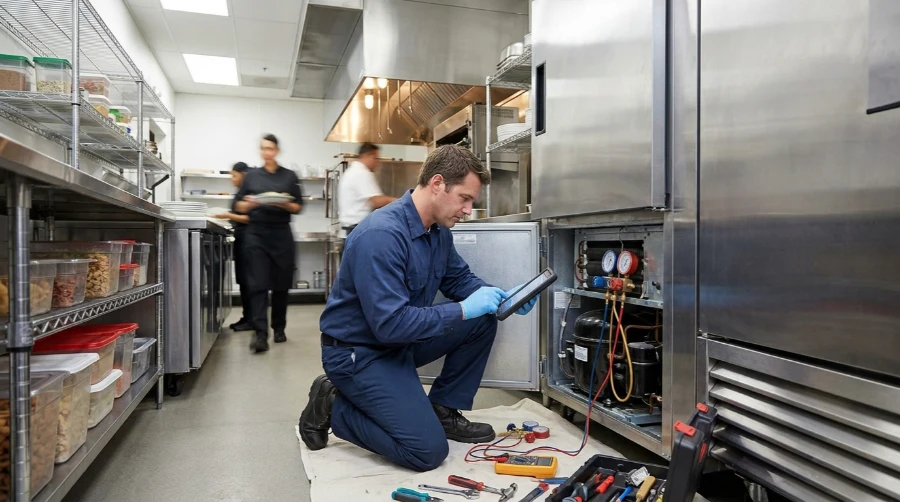
A broken appliance in a home kitchen is an inconvenience. A broken appliance in a commercial kitchen is lost product, a shortened menu, an unhappy dining room, and in some cases a health-code problem you didn’t sign up for. We work on the equipment that keeps a commercial kitchen legal and running, not just the equipment that keeps it convenient.
Equipment breadth
We work across cold-side refrigeration (walk-ins, reach-ins, ice machines, prep tables), hot-side cooking equipment (ranges, fryers, ovens, griddles), warewashing (dish machines, booster heaters) and on-premise laundry, so you are not juggling three different vendors for three different failures.
We understand what “down” actually costs you
A failed walk-in isn’t a maintenance ticket, it’s product loss on top of the repair bill. We treat commercial calls with that urgency built in, not bolted on.
We know what Austin does to commercial equipment
Central Texas hard water and summer grid strain hit high-throughput commercial units, such as ice machines running around the clock and walk-in compressors that never fully cycle off, harder and faster than they hit a home refrigerator. More on that below.
Commercial Kitchen Equipment We Repair
Refrigeration & cold storage
- Walk-in coolers and walk-in freezersCompressor failures, door seal and gasket wear, evaporator coil icing, temperature drift.
- Reach-in refrigerators and freezersCondenser fan failure, thermostat and control board issues, door hinge and gasket replacement.
- Commercial ice machinesScale buildup on the water valve and evaporator plate, slow ice production, cloudy or undersized cubes, complete production stoppage.
- Undercounter and prep-table refrigerationSandwich and pizza prep units, condensation issues, inconsistent holding temperatures.
- Beverage and draft coolersCompressor cycling problems, glycol line issues on draft systems.
- Display cases and merchandisersRetail and grab-and-go cold cases losing temperature.
Cooking equipment
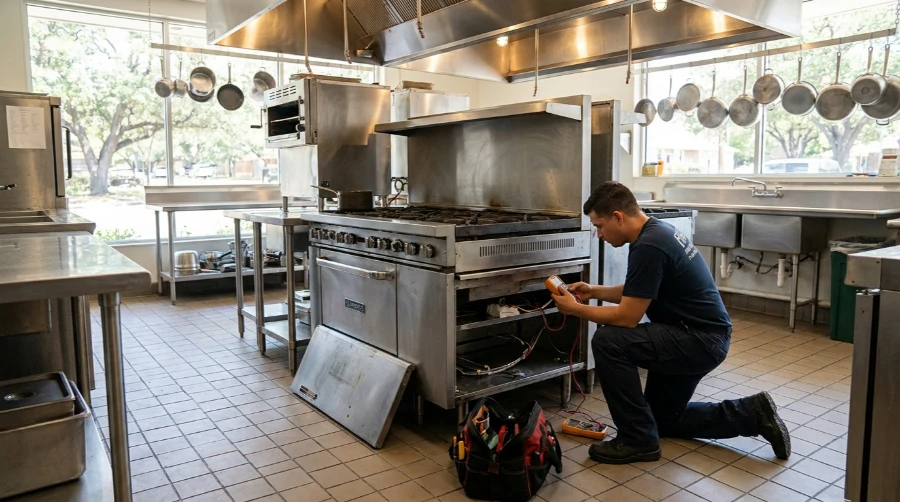
- Commercial ranges and griddlesBurner ignition failure, uneven heat, gas valve and regulator issues.
- FryersThermostat drift, heating element failure, oil temperature inconsistency.
- Combi ovens and steamersControl board faults, steam generation issues, water and scale-related component failure.
- Convection ovensFan motor failure, uneven baking, door seal issues.
- Pizza ovens, deck and conveyorConveyor belt and chain issues, heating zone inconsistency.
Warewashing
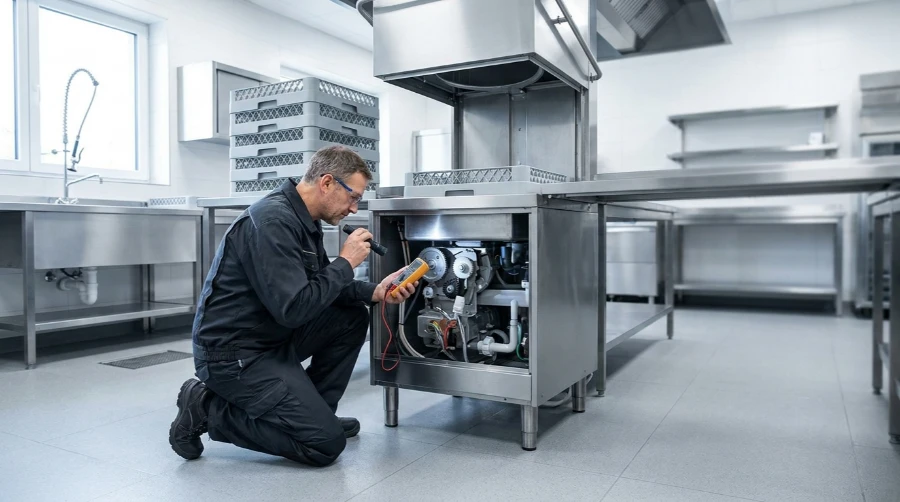
- Commercial dishwashers and dish machinesDoor-type, undercounter and conveyor: wash arm clogging from mineral scale, pump failure, poor drying results.
- Sanitizing failuresLow-temp chemical sanitizer dosing issues, and high-temp booster heater failures that put your final rinse temperature out of compliance.
Laundry
- On-premise laundry (OPL) washer-extractors and commercial dryersFor hotels, spas and restaurants running their own linen service.
If your equipment isn’t listed above, call and describe the make, model and symptom. Most commercial kitchen equipment shares the same handful of failure points across brands.
If your premises also runs domestic-style equipment, such as the refrigerator and dishwasher in a break room or a rental unit, those are covered on our refrigerator and freezer repair and dishwasher repair pages.
Diagnose, Explain, Then Quote. In That Order.
Diagnose on site
A technician finds the actual fault on the actual unit, rather than guessing from a description of the noise it is making.
Explain what failed
You get told which part has gone and why, in language you can repeat to an owner or a manager without needing a technical glossary.
Quote a flat price
One number for the repair, given before any work starts. If you decide not to go ahead, that is a normal answer and the visit ends there.
That order matters more in a commercial kitchen than it does in a house. The person standing next to the equipment often has to explain the problem to somebody else, frequently somebody who has never seen the unit, and get a yes before work can start. So the explanation is not a courtesy, it is the part that makes the decision possible. Because the price is flat rather than hourly, the figure you pass on is the figure on the invoice.
What to Have Ready When You Call
Three details get a commercial call scheduled and prepped correctly the first time, which matters more when a kitchen is mid-service.
The make and model
Most commercial kitchen equipment shares the same handful of failure points across brands, so the model number usually tells us what is likely to have gone before a technician leaves. On most units the model and serial plate is inside the door frame, behind the kick plate, or on the back panel.
The symptom, precisely
“Holding at 48 degrees since last night” is a different call from “not cooling at all,” and a dish machine that is inconsistent on the final rinse is different from one that will not fill. The more exact the symptom, the better the odds the right part is already on the truck.
Access and timing
Tell us your service windows and who will be on site to let a technician in. If you are a food truck or trailer, say so when you call, because access and power draw are different from a fixed kitchen and the visit gets prepped differently.
What Actually Breaks Commercial Equipment in Austin, and Why
This is the part most repair sites skip past with a generic “we fix all brands” line. Here is what is actually happening to your equipment in this specific market.
Hard water is harder on commercial volume
Austin sits on Edwards Aquifer limestone, and the water coming out of your kitchen’s tap carries more dissolved mineral content than water in most U.S. cities. Austin Water reports hardness around 93 ppm. In a home kitchen that shows up slowly. In a commercial kitchen it shows up fast, because the volume is so much higher.
Ice machines run near-continuously, so scale builds on the water inlet valve and evaporator plate at a pace that can shrink cube size or shut production down entirely within months of a machine going unmaintained, not years.
Combi ovens and steamers use direct water injection for steam generation, and mineral scale on internal steam components is one of the most common reasons a combi oven starts underperforming or throwing error codes.
Dish machines rely on rinse water hitting the plate cleanly. Scale on wash arms and jets is a direct cause of the spotting and film that shows up on glassware and flatware.
If your kitchen is on Austin municipal water and you haven’t had scale-prone equipment descaled recently, that is usually the first thing worth checking before assuming a bigger component has failed. Our Austin hard water guide covers the underlying chemistry in more detail.
Summer heat and grid strain hit refrigeration compressors hardest
Austin summers push the ERCOT grid close to its limits during peak demand, and that shows up as voltage fluctuation, not just outages. Commercial refrigeration compressors are already working harder in summer because ambient kitchen temperatures climb and door-open frequency goes up during a rush. Add grid voltage sag into that mix and you get compressor and control-board stress that compounds over a season, not just on the worst days.
Walk-ins and reach-ins that run marginal all summer are the units most likely to fail completely once the first real cold front hits in fall, because that is when a compressor already worn down finally gets pushed past its limit by a swing in ambient temperature.
Winter freeze events are a real, recurring risk
Central Texas has seen real winter storm events in recent years that caught commercial kitchens off guard, particularly in older buildings with exterior-wall plumbing or exposed condenser lines.
A walk-in with refrigerant or water lines running along an exterior wall is more exposed here than it would be in a building designed for sustained freezing weather. If your kitchen has equipment in that kind of location, it is worth a look before the next freeze warning, not after a line has already cracked.
The Part Competitors Don’t Talk About: Health Inspections
This is the section that actually matters if you run a restaurant in Austin, and almost no repair company writes about it directly.
Austin restaurants are inspected by Austin Public Health’s Environmental Health Services Division under the Texas Food Establishment Rules (TFER). Inspectors score each visit out of 100, deducting points for violations found, and the city publishes those scores as open data. A citywide median score sits in the low-to-mid 90s, which means most Austin kitchens are doing this well, but a broken piece of equipment is one of the fastest ways to lose points you didn’t expect to lose.
Cold-holding above 41°F
If a walk-in or reach-in can’t hold potentially hazardous food at or below that threshold, it is a violation regardless of how good the rest of your kitchen looks. A unit that is “running a little warm” isn’t a minor issue from an inspection standpoint, it is a temperature-log problem waiting to happen.
Dish machine sanitizing failures
Whether your kitchen uses a low-temp chemical-sanitizing machine or a high-temp booster-heated final rinse, if that step isn’t hitting its target consistently it is a direct compliance issue, not just a “the glasses look a little spotty” issue.
If your equipment is showing early warning signs, such as a walk-in running slightly warmer than it used to or a dish machine that is inconsistent on the final rinse, addressing it before your next inspection cycle is a lot less disruptive than addressing it after a failed score.
Who We Work With
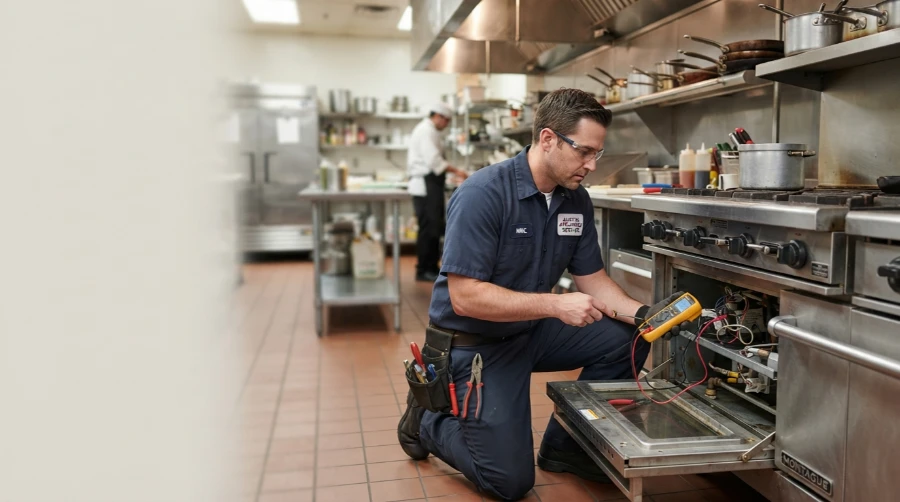
- Independent restaurants and full-service kitchensThe widest range of equipment types, and usually the most time-sensitive calls.
- Bars, breweries and taproomsDraft and beverage cooling, ice production, and limited kitchen equipment.
- Hotels and hospitality kitchensBanquet and back-of-house equipment, plus on-premise laundry.
- Food trucks and trailersCompact refrigeration and cooking equipment, with tighter power and access constraints than a fixed kitchen.
Commercial Appliance Repair Austin and Nearby Areas
We serve commercial kitchens throughout the Austin metro.
Frequently Asked Questions
How much does commercial appliance repair cost in Austin?
How fast can you get to an emergency equipment failure?
Do you work on my equipment brand?
Can hard water actually damage a commercial ice machine that badly?
What temperature does a walk-in cooler need to hold for health inspections?
Do food trucks need a different kind of service than a restaurant?
Tell us what has stopped working
Call with the make, model and symptom and we will tell you what happens next. You can also browse everything we work on from the services overview.
Licensed and insured. Serving commercial kitchens across Austin and the surrounding metro.