
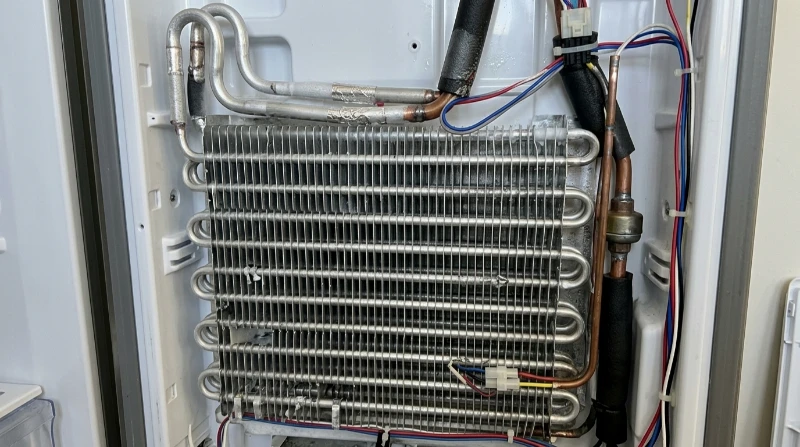
A refrigerator temperature sensor problem can cause surprisingly strange behavior.
Your refrigerator may feel too warm even though the compressor is running. Food may freeze in the fresh food section. The appliance may run almost nonstop, cycle at the wrong times, or display an error code.
The problem is often related to a component called a thermistor, which measures temperature and sends information to the refrigerator’s electronic control system.
When that information is inaccurate, the control board may make the wrong decisions about cooling, fan operation, or defrosting.
A temperature sensor is only one possible cause of a refrigerator cooling problem, however. Blocked airflow, frost buildup, a defective evaporator fan, a failed defrost component, damaged wiring, or a control board fault can create similar symptoms.
That is why replacing the sensor without testing it first is not always the right repair.
What Is a Refrigerator Temperature Sensor?
A refrigerator temperature sensor is a small component that monitors the temperature inside a refrigerator or freezer compartment.
Most modern refrigerators use a thermistor as the temperature sensing device. A thermistor changes its electrical resistance as its temperature changes. The refrigerator’s electronic control system uses that changing signal to determine how cold the compartment is.
The control system can then make decisions about refrigerator operation.
Depending on the refrigerator design, the sensor’s information may influence:
- Compressor operation
- Evaporator fan operation
- Defrost operation
- Airflow control
- Temperature regulation
- Cooling cycles
- Error detection
Modern refrigerators may contain more than one temperature sensor. There can be separate sensors for the fresh food compartment, freezer, evaporator area, or other locations.
The exact arrangement depends on the manufacturer and model.
For example, GE refrigerators use temperature sensor components designed for specific models, while other manufacturers use different thermistor assemblies and control strategies.
What Does a Refrigerator Thermistor Do?
Think of the thermistor as the refrigerator’s temperature feedback device.
The cooling system does not simply run at full power all day. The control system needs information about actual temperature so it can determine when cooling is needed.
The thermistor provides that information.
If the refrigerator is warmer than expected, the control system can respond by operating the cooling system.
If the refrigerator reaches the desired temperature, the system can reduce or stop cooling according to the appliance’s programmed operating cycle.
When the thermistor sends an incorrect signal, the refrigerator may respond as though the compartment is warmer or colder than it really is.
That explains why a faulty temperature sensor can produce two apparently opposite symptoms.
The refrigerator can become too warm, or it can become too cold.
Repair documentation from Sears PartsDirect explains that a faulty thermistor can provide incorrect temperature information to the electronic control board, resulting in a refrigerator that is either too cold or not cold enough.
What Are the Symptoms of a Bad Refrigerator Temperature Sensor?
A faulty sensor does not always produce one obvious symptom.
The most useful clues are changes in temperature, unusual cycling, and behavior that does not match the refrigerator’s settings.
Common refrigerator temperature sensor problems include:
- Refrigerator too warm
- Refrigerator too cold
- Food freezing in the fresh food compartment
- Temperature fluctuations
- Compressor running longer than normal
- Refrigerator cycling too frequently
- Freezer temperature problems
- Frost related symptoms
- Error codes on some models
- Cooling that does not match the selected setting
Several of these symptoms can also come from completely different components.
That is why symptom recognition should be followed by testing.
Refrigerator Too Warm but Freezer Still Works
This is one of the more confusing refrigerator complaints.
The freezer may remain reasonably cold while the refrigerator section becomes noticeably warmer.
A temperature sensor could be responsible, but it is not the only possibility.
The refrigerator compartment depends on proper airflow in many designs. If an evaporator fan is not moving air correctly, if a damper is malfunctioning, or if frost is blocking the evaporator coil, the fresh food section can warm up.
A faulty temperature sensor can also give the control board incorrect information and interfere with normal cooling operation.
So when the freezer is cold and the refrigerator is warm, several areas should be considered before replacing the thermistor.
Refrigerator Too Cold and Food Is Freezing
A bad temperature sensor does not always make the refrigerator warmer.
It can also make the refrigerator excessively cold.
If the sensor incorrectly reports that the compartment is warmer than it really is, the control system may continue cooling when less cooling is actually needed.
You may notice:
- Lettuce freezing
- Milk becoming partially frozen
- Drinks freezing near the back wall
- Ice developing in unusual areas
- Fresh food temperatures dropping below the intended setting
LG specifically notes that food placed in front of a temperature sensor can interfere with its ability to correctly detect temperature. The manufacturer also explains that blocking the sensor or nearby airflow can contribute to excessive cooling.
This is an important distinction.
Not every refrigerator that freezes food has a defective sensor. Sometimes the sensor is simply obstructed by stored food.
Refrigerator Runs Constantly
A refrigerator that never seems to stop running can have a sensor problem.
If the control system receives a temperature signal indicating that the refrigerator has not reached its target temperature, it may continue the cooling cycle.
However, continuous operation can also result from:
- Dirty condenser coils
- Poor condenser airflow
- A damaged door gasket
- Heavy frost buildup
- A weak evaporator fan
- A condenser fan problem
- Low refrigerant
- A compressor problem
- A control board issue
A technician therefore has to determine whether the refrigerator is actually staying warm or whether the sensor is simply reporting an incorrect temperature.
That distinction can save you from replacing the wrong component.
Refrigerator Temperature Keeps Fluctuating
Temperature swings are another clue worth paying attention to.
A refrigerator should naturally cycle rather than maintain exactly the same temperature every second. Some variation is normal.
Large or persistent fluctuations are different.
Possible causes include:
- Faulty thermistor
- Poor sensor placement
- Damaged wiring
- Control board problem
- Defrost problem
- Airflow restriction
- Door seal failure
- Excessive door opening
- Incorrect temperature setting
A sensor problem becomes more suspicious when the physical temperature does not agree with the refrigerator’s programmed behavior.
For example, the display may indicate one temperature while an independent appliance thermometer shows a substantially different result.
A mismatch does not prove that the thermistor has failed, but it is useful diagnostic evidence.
Can a Temperature Sensor Cause a Refrigerator Not to Cool?
Yes, a faulty sensor can contribute to inadequate cooling.
The sensor itself does not create cold air. Instead, it provides temperature information to the refrigerator’s control system.
If that information is inaccurate, the appliance may not operate the cooling system at the correct time or for the correct duration.
That means the sensor can indirectly cause a refrigerator to become too warm.
However, the same symptom can result from a compressor problem, fan failure, defrost problem, airflow restriction, or sealed system issue.
This is why refrigerator temperature sensor diagnosis should be based on the appliance’s actual behavior and electrical readings rather than the symptom alone.
Where Is the Temperature Sensor Located?
There is no universal sensor location.
Manufacturers position thermistors differently depending on refrigerator design.
A sensor may be located:
- Inside the refrigerator compartment
- Near an air outlet
- Behind an interior panel
- In the freezer
- Near the evaporator coil
- Inside a sensor housing
- Behind a cover or control assembly
Some refrigerators use multiple sensors.
LG explains that sensor locations vary by model and that some refrigerator designs place the sensor toward the upper portion of the refrigerator compartment.
The exact location should be confirmed using the model’s service documentation rather than guessing.
What Happens When a Refrigerator Sensor Goes Bad?
There are several ways a thermistor can fail.
The sensor may develop an incorrect resistance value.
It may become electrically open.
It may develop a short circuit.
Its wiring connector may become loose.
The wire harness may become damaged.
Moisture or physical damage may interfere with the component.
The refrigerator’s control board can also have a problem reading an otherwise healthy sensor.
This last point matters.
A sensor and the control board are part of the same electrical feedback system. A failed sensor is not the only explanation for an abnormal temperature reading.
Repair technicians often test both the sensor and the circuit that connects it to the control system. Sears PartsDirect specifically recommends checking the thermistor and its wiring before concluding that the sensor is defective.
How Do You Test a Refrigerator Temperature Sensor?
Testing methods vary by model, so the manufacturer’s service information should be used whenever possible.
A common diagnostic method is to measure the thermistor’s electrical resistance with a multimeter.
Because the thermistor’s resistance changes with temperature, the expected reading depends on the temperature of the sensor.
The refrigerator’s technical documentation may provide a temperature versus resistance chart.
For example, a service technician may compare the measured resistance with the manufacturer’s specified value at a known temperature.
If the reading is far outside the expected range, the thermistor may be defective.
The test can also help identify an open or shorted circuit.
Sears PartsDirect notes that the refrigerator’s technical documentation can include the resistance values expected from the thermistor at different temperatures.
Important safety point
A refrigerator contains electrical components and should be disconnected from power before accessing internal electrical parts.
Do not probe energized circuits unless you have the training and equipment required for that testing.
For homeowners, checking the refrigerator’s symptoms, temperature, settings, vents, and visible sensor area is generally safer than opening electrical compartments.
Can You Replace a Refrigerator Temperature Sensor Yourself?
Some thermistor replacements are relatively straightforward from a parts standpoint.
That does not mean every refrigerator sensor replacement is a simple DIY job.
The difficulty depends on:
- Refrigerator design
- Sensor location
- Access to the wiring
- Connector type
- Whether the sensor is clipped into place
- Whether the sensor is integrated into an assembly
- Whether diagnosis is already confirmed
The bigger challenge is often not physical replacement.
It is knowing whether the sensor is actually defective.
Replacing a $30 or $50 component does not solve the problem when the real fault is a defrost heater, evaporator fan, damaged wiring, control board, or sealed system problem.
This is particularly important when the refrigerator has multiple sensors.
What Is the Difference Between a Thermistor and a Thermostat?
The terms are often confused.
A thermistor is a temperature sensing device that changes resistance as temperature changes.
A thermostat is a control device that regulates operation based on temperature.
Older refrigerator designs may use mechanical thermostats, while many modern appliances use electronic temperature sensors connected to a control board.
That difference matters when diagnosing a refrigerator.
A refrigerator advertised as having a “temperature control problem” does not necessarily need a thermostat replacement.
The actual system may use thermistors, electronic controls, sensors, or a combination of components.
Temperature Sensor vs Evaporator Fan Problem
These two failures can look similar.
Both may cause the refrigerator section to become too warm.
An evaporator fan problem typically affects cold air circulation. In many refrigerator designs, the evaporator fan moves cold air from the evaporator area through the refrigerator compartments.
If the fan stops, the freezer may remain relatively cold while the fresh food area struggles.
A sensor problem, by comparison, concerns the accuracy of temperature feedback and the decisions made by the control system.
A technician can distinguish between them by checking fan operation, temperature behavior, sensor readings, wiring, and control signals.
Repair sources also note that an evaporator fan failure can leave the freezer cold while the refrigerator compartment remains warm, which demonstrates why the symptom alone is not enough to identify a sensor failure.
Temperature Sensor vs Defrost System Problem
Defrost problems create another common diagnostic trap.
If the evaporator coil becomes covered with excessive frost, airflow can be reduced dramatically.
The refrigerator may then become warm even though the compressor is operating.
A temperature sensor can be involved because some refrigerator designs use temperature sensing as part of defrost control, but the actual failed component might instead be:
- Defrost heater
- Defrost thermostat
- Defrost sensor
- Wiring
- Control board
- Other defrost control components
The visible frost is therefore an important clue, but it does not automatically identify which component has failed.
Can a Bad Sensor Cause Ice Buildup?
It can contribute to abnormal cooling or defrost behavior depending on the refrigerator’s design.
A sensor provides temperature information to the control system. If that information is incorrect, the system may not make the expected cooling or defrost decisions.
But ice buildup can have many causes.
Poor door sealing, high humidity, airflow problems, defrost component failures, and other system faults can also produce frost.
A useful diagnostic question is whether the frost pattern is normal for that particular refrigerator.
Heavy, recurring frost is a reason to investigate the defrost and airflow systems rather than simply replacing the temperature sensor.
Can a Blocked Sensor Cause Problems?
Yes.
This is one issue homeowners can sometimes correct without replacing anything.
If food, packaging, or another object is directly covering the sensor, the sensor may not accurately measure the surrounding air.
LG specifically advises organizing food so it does not obstruct the temperature sensor, because blocked sensing can cause incorrect temperature control and excessive cooling.
Before assuming the sensor has failed, inspect the area around it.
Do not press food against the sensor.
Do not cover it with plastic or packaging.
And do not move internal components unless the owner’s manual allows it.
What Error Codes Can Mean a Sensor Problem?
Some refrigerators display diagnostic codes when the control system detects a sensor or thermistor problem.
The exact code depends on the manufacturer and model.
There is no universal refrigerator temperature sensor error code.
Certain Whirlpool, Frigidaire, General Electric, and other models use brand specific codes for temperature or thermistor faults.
If an error code appears, look up the code using the exact model number.
Do not assume every cooling related code means the sensor itself must be replaced.
The code may point toward a circuit, sensor, control, or related fault that requires further testing.
Refrigerator Temperature Sensor Problems in Smart Refrigerators
Modern refrigerators can use substantially more electronics than older models.
Some smart refrigerators integrate electronic controls, multiple temperature sensors, connected diagnostics, and inverter compressor technology.
That creates more possible failure points.
A smart refrigerator can report an error, show a temperature on the display, or communicate with an app while still having a physical sensor or wiring problem.
An electronic display should therefore not be treated as proof that the actual cabinet temperature is correct.
Use an independent appliance thermometer when verifying temperature.
LG’s current support guidance similarly recommends temperature measurement and points out that model specific electronic errors may require professional inspection.
How to Check Whether the Refrigerator Is Actually Too Warm
Before blaming the sensor, measure the temperature properly.
Place an appliance thermometer in an appropriate location inside the refrigerator and allow enough time for the reading to stabilize.
Opening the door repeatedly can change the temperature.
The location of the thermometer also matters.
The goal is to understand the actual cabinet temperature rather than relying on how the air feels when the door opens.
For food safety, the FDA recommends keeping refrigerators at 40°F or below.
If your refrigerator display says 37°F but the actual measured temperature remains significantly warmer, that information can be useful during diagnosis.
It does not automatically prove the sensor is bad, but it tells the technician that the temperature control system deserves attention.
Common Refrigerator Temperature Sensor Mistakes
Replacing the sensor without testing it
A sensor may be inexpensive compared with a compressor, but replacing unnecessary parts still costs money and time.
Assuming the display temperature is accurate
The number on the screen is a control reading, not necessarily a direct measurement of every area inside the cabinet.
Ignoring the wiring
A healthy thermistor cannot work properly if its connector or harness is damaged.
Confusing frost with sensor failure
Heavy frost often points toward an airflow or defrost issue that deserves separate investigation.
Replacing the control board first
Control boards are expensive. A technician should rule out simpler problems before recommending board replacement.
Blocking the sensor with food
A sensor covered by stored food cannot accurately sample the intended environment.
Testing resistance without the manufacturer’s chart
Thermistors do not all have the same resistance characteristics. A reading only has meaning when compared with the specification for that refrigerator.
When Should You Call a Refrigerator Repair Technician?
Professional refrigerator repair becomes the better option when basic checks do not solve the problem or when diagnosis requires electrical testing.
Consider calling a technician when:
- The refrigerator remains above the safe temperature range.
- Food is repeatedly freezing despite normal settings.
- The refrigerator runs constantly.
- The freezer and refrigerator temperatures behave abnormally.
- A temperature sensor error code appears.
- The sensor wiring looks damaged.
- A replacement sensor does not solve the problem.
- Frost keeps returning.
- The compressor or fan is behaving unusually.
- You suspect the control board.
- You suspect a sealed system or refrigerant problem.
A technician should diagnose the system rather than automatically replacing the sensor.
What Should a Technician Check?
A proper refrigerator temperature sensor diagnosis can involve several steps.
Measure actual cabinet temperature
This establishes whether the refrigerator is truly too warm or too cold.
Review the symptoms
The technician should determine whether the issue affects the refrigerator section, freezer section, or both.
Inspect the sensor
The sensor and its mounting location should be checked for physical damage or obstruction.
Inspect the wiring
The harness and connectors should be checked for loose, broken, corroded, or damaged connections.
Test the thermistor
The resistance should be compared against the model’s expected values.
Check related components
Depending on symptoms, the technician may inspect fans, defrost components, airflow paths, damper operation, compressor operation, and the control board.
Confirm the repair
After replacement or repair, the refrigerator should be allowed to operate and its cooling performance should be verified.
This approach matters because the sensor is part of a larger refrigeration control system.
Refrigerator Temperature Sensor Repair in Austin, TX
Austin homeowners deal with the same refrigerator components found throughout the United States, including thermistors, electronic temperature controls, evaporator fans, defrost systems, condenser fans, compressors, and door gaskets.
What matters locally is finding a technician who understands the specific refrigerator rather than treating every cooling complaint as the same repair.
A proper refrigerator repair appointment should begin with diagnosis.
Give the technician the refrigerator brand and model number when scheduling service.
Also describe the symptoms as specifically as possible.
For example, saying “the refrigerator is warm but the freezer is cold, and the compressor runs continuously” gives a technician more useful information than simply saying “my fridge is broken.”
Photos of the model label, display, frost buildup, or visible damage can also help a technician understand the situation before arriving.
Refrigerator Brands That May Use Thermistors
Temperature sensing systems are common across modern refrigerator brands.
Depending on the specific model, technicians may encounter thermistors and temperature sensors in refrigerators from brands such as:
- Samsung
- LG
- Whirlpool
- GE
- Frigidaire
- Maytag
- KitchenAid
- Kenmore
- Bosch
- Electrolux
- Sub-Zero
The exact sensor design and resistance specifications differ between models.
A part that fits one refrigerator is not automatically correct for another refrigerator from the same brand.
The correct replacement should be matched using the model number and appropriate parts documentation.
Repair providers serving Austin commonly advertise service for major refrigerator brands, but brand coverage does not eliminate the need for model specific diagnosis.
How Much Does Refrigerator Temperature Sensor Repair Cost?
The final cost depends on the refrigerator model, the location of the sensor, accessibility, diagnostic requirements, labor rates, and whether another component has failed.
The sensor itself may be less expensive than major refrigerator components, but the total repair can include diagnosis and labor.
A simple sensor replacement is very different financially from a repair involving a control board, sealed refrigeration system, or compressor.
Be cautious of any estimate made solely from the symptom.
“Refrigerator is warm” is not enough information to determine that a thermistor has failed.
A trustworthy repair estimate should be based on what the technician actually finds.
Is It Worth Replacing a Refrigerator Temperature Sensor?
In many cases, a properly diagnosed sensor failure is a reasonable repair.
The answer becomes more complicated when the refrigerator is older or when multiple expensive components are failing.
Consider:
- Appliance age
- Overall condition
- Previous repairs
- Sensor replacement cost
- Control board condition
- Compressor condition
- Sealed system condition
- Parts availability
- Energy efficiency
- Replacement appliance cost
A refrigerator with one failed sensor may be worth repairing.
An older refrigerator with a failed sensor plus compressor or sealed system problems may deserve a replacement comparison.
How to Prevent Temperature Sensor Problems
You cannot prevent every electronic component from eventually failing, but good refrigerator maintenance can reduce avoidable problems.
Keep the sensor area clear.
Do not pack food directly against air vents.
Keep the refrigerator reasonably organized so cold air can circulate.
Inspect the door gasket periodically.
Clean accessible condenser areas according to the manufacturer’s recommendations.
Avoid placing the refrigerator where ventilation requirements are not met.
Do not ignore unusual temperature fluctuations.
Early attention can prevent a small performance problem from becoming a larger food safety or appliance issue.
Frequently Asked Questions
1: What are the signs of a bad refrigerator temperature sensor?
Common signs include unusual temperature fluctuations, food freezing unexpectedly, a refrigerator that is too warm, excessive or unusual compressor runtime, and sensor related error codes on some models. These symptoms can also be caused by other components, so testing is important.
2: Can a refrigerator temperature sensor stop cooling?
A faulty sensor can interfere with the control system’s cooling decisions and contribute to inadequate cooling. However, a warm refrigerator can also result from airflow problems, fan failures, defrost faults, compressor issues, or sealed system problems.
3: How do I know if my thermistor is bad?
A technician can test the thermistor’s resistance and compare the measurement with the manufacturer’s specified temperature and resistance values. The sensor circuit and wiring should also be checked before replacing the part.
4: Can a bad thermistor cause a refrigerator to freeze food?
Yes. An incorrect temperature signal can cause the control system to continue cooling when it should not. However, blocked sensors, airflow problems, control issues, and incorrect settings can produce similar symptoms.
5: Where is the thermistor located in a refrigerator?
The location depends on the model. It may be inside the fresh food compartment, freezer, evaporator area, or behind an interior panel. Some refrigerators use multiple temperature sensors.
6: Is a thermistor the same as a temperature sensor?
A thermistor is one type of temperature sensing device. Refrigerator manufacturers commonly use thermistors to monitor internal temperatures and provide feedback to the electronic control system.
7: Can I replace a refrigerator thermistor myself?
Some models allow relatively simple thermistor replacement, but diagnosis is the more important part. If the sensor is not actually defective, replacing it will not solve the cooling problem.
8: Why is my refrigerator warm but the freezer is cold?
Possible causes include restricted airflow, an evaporator fan problem, excessive frost, damper problems, sensor issues, and other cooling control faults. The symptom alone does not identify the failed component.
9: Does a refrigerator sensor need calibration?
Most refrigerator thermistors are not manually calibrated like a laboratory thermometer. They are designed to provide a specific electrical response that the refrigerator’s control system interprets. Replacement parts must match the appliance’s specifications.
10: Should I call a local refrigerator repair service in Austin?
If the refrigerator remains too warm, food is freezing unexpectedly, an error code appears, or the sensor and related components need electrical testing, professional diagnosis is appropriate. An Austin refrigerator repair technician can determine whether the problem is actually the thermistor or another part of the cooling system.
Conclusion
A refrigerator temperature sensor is a small component with a big job.
It tells the control system what is happening with temperature inside the appliance. When that information becomes inaccurate, the refrigerator may cool too much, cool too little, cycle abnormally, or behave in ways that seem unrelated to a small sensor.
The key is not to confuse a symptom with a diagnosis.
A warm refrigerator does not automatically mean the thermistor has failed. Check actual temperature, settings, airflow, sensor obstruction, frost buildup, and other obvious conditions first.
When the problem continues, professional testing can determine whether the fault is the temperature sensor, its wiring, the control board, a fan, the defrost system, or another part of the refrigeration system.
For homeowners in Austin, TX, that diagnostic step is often the difference between replacing one necessary component and spending money on parts that were never the problem.