
Austin Hard Water Appliance Damage: What Homeowners Should Know
Austin Hard Water Appliance Damage
Austin’s water contains measurable calcium and magnesium hardness. Austin Water’s 2025 report recorded an average total hardness of 93 ppm (5.4 gpg), with reported values ranging from 70 to 126 ppm. Hardness itself does not mean the water is unsafe, but dissolved minerals can contribute to scale and deposits in water-contact equipment over time.
That single distinction, hard water is not the same thing as unsafe water, shapes everything else in this guide. The sections below walk through what Austin’s numbers actually mean, how mineral scale forms, and which appliances have a real, evidence-backed relationship to hard water versus which ones don’t.
How Hard Is Austin Water?
- 93 ppmAverage hardness
- 5.4 gpgAverage hardness
- 70–126 ppmReported range
Source: Austin Water’s 2025 Annual Drinking Water Quality Report.
Austin Water’s 2025 Annual Drinking Water Quality Report (the Consumer Confidence Report the city publishes annually under EPA requirements) lists total hardness (as calcium carbonate) from a low of 70 ppm to a high of 126 ppm, with an average of 93 ppm. In grains per gallon, that’s a range of 4.1 to 7.4 gpg, averaging 5.4 gpg. Austin Water attributes the hardness to naturally occurring calcium.
Hardness is a measure of dissolved calcium and magnesium, reported as an equivalent concentration of calcium carbonate. It’s expressed in parts per million (ppm, the same as milligrams per liter) or in grains per gallon (gpg), a unit mainly used in the water-softening industry, where one grain equals approximately 17.1 ppm.
The standard classification scale, from the U.S. Geological Survey, is:
| Classification | Range (mg/L as CaCO3) |
|---|---|
| Soft | 0–60 |
| Moderately hard | 61–120 |
| Hard | 121–180 |
| Very hard | Above 180 |
Austin’s average hardness (93 ppm) places it in the moderately hard range. Even the highest value in Austin Water’s reported range (126 ppm) only slightly crosses into hard, and stays well short of the 180 ppm threshold for “very hard.”
A figure of 240 ppm circulates in some online sources describing Austin as “very hard” water; that number is not consistent with Austin Water’s own reported data and shouldn’t be treated as accurate.
Austin Water reports one system-wide range rather than a breakdown by neighborhood or ZIP code, so some of the spread between 70 and 126 ppm likely reflects variation across sampling locations or time of year, but there isn’t published data specifying hardness at a more granular level.
It’s worth repeating: hardness is not a regulated contaminant, and the EPA doesn’t treat it as a health or safety issue. Austin Water reports it as an aesthetic/informational water-quality measure, similar to pH.
What Hard Water Does Inside Appliances
Dissolved calcium and magnesium don’t cause problems simply by being present in water. The issue starts when those minerals stop being dissolved.
- Step 1Dissolved calcium and magnesium
- Step 2Water is heated
- Step 3Minerals become less soluble and precipitate
- Step 4Solid calcium carbonate forms as scale
As water is heated, calcium and magnesium become less soluble and begin to precipitate, coming out of solution as solid calcium carbonate. That solid deposit is scale, and it forms preferentially wherever heating happens repeatedly: heating elements, tank walls, and other surfaces that see sustained water contact under heat. Scale can also form more slowly in components that hold still water or filter it repeatedly, like inlet valve screens and fill tubes, even without direct heating.
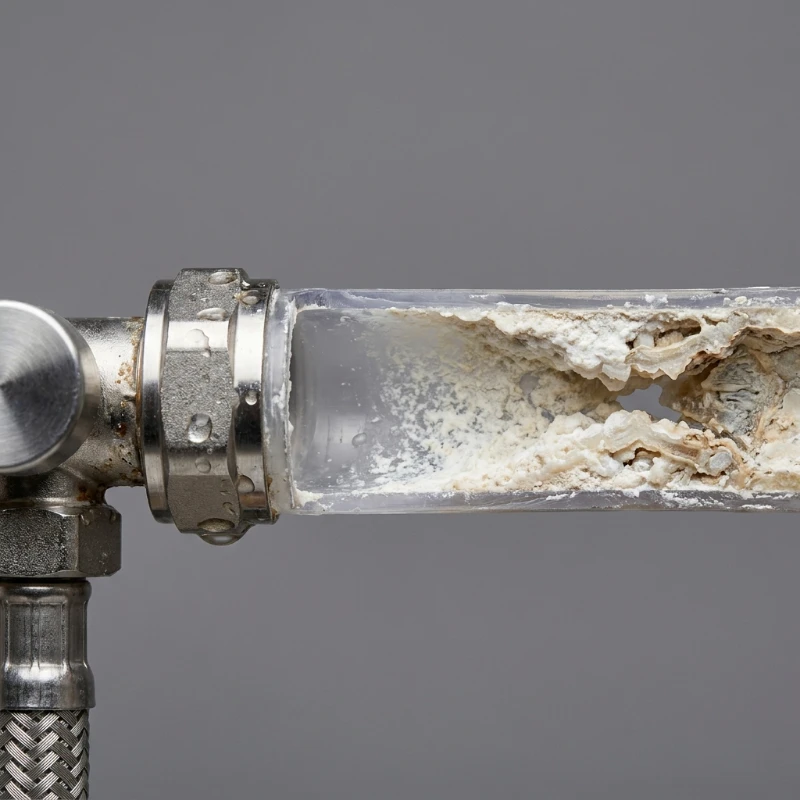
This explains why hard-water issues concentrate in specific appliances instead of spreading evenly through a house. An appliance that heats water repeatedly, or holds water in continuous contact with a narrow passage or screen, is mechanically different from an appliance that never touches water at all, which is a distinction the appliance sections below rely on directly.
Dishwashers
Hard Water and Dishwashers
Hard water’s clearest, most consistently documented effect on any appliance is on dishwashers, primarily as a cleaning and cosmetic issue rather than a mechanical one.
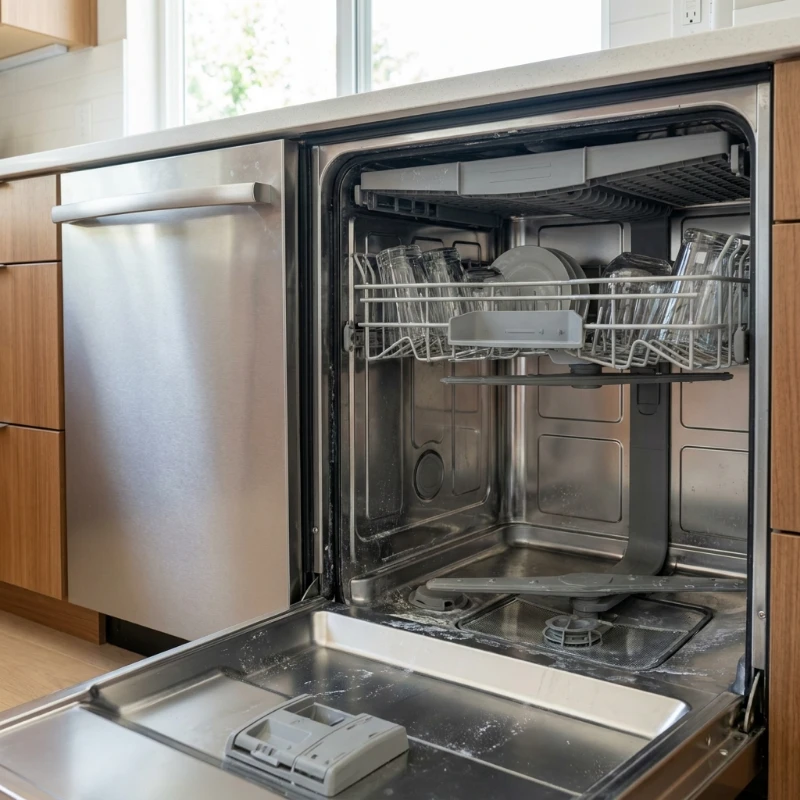
Cloudy glassware and a white, filmy residue on dishes are the classic symptoms. According to Cascade’s own consumer guidance, that film is largely made up of calcium, magnesium, and aluminum reacting with detergent residue, not a sign of a malfunctioning dishwasher. Whirlpool’s product support content confirms the same pattern and recommends detergent pods or tablets over powder, liquid, or gel (shown in testing to reduce filming more effectively), a rinse aid to limit repeat buildup, and a wash temperature of at least 120°F to help prevent spotting.
On the question of actual mechanical damage, Whirlpool’s support documentation is specific: it names 15 grains per gallon or more as “extremely hard water” that “can damage your dishwasher and make good results difficult to achieve,” and recommends a water softener at that level.
Austin’s water, averaging 5.4 gpg and topping out at 7.4 gpg in Austin Water’s reported range, stays well under that 15 gpg threshold. That means Austin dishwashers are more realistically dealing with the cosmetic and cleaning-performance effects of hard water than the mechanical-damage threshold manufacturers describe for genuinely extreme hardness.
Spotting and filming that don’t improve with a detergent or rinse-aid change, or visible scale on spray arms that home cleaning doesn’t clear, can be a sign it’s worth having a dishwasher looked at professionally.
Washing machines
Hard Water and Washing Machines
The connection between hard water and washing machines is plausible and consistently reported by appliance-repair sources, though it isn’t backed by the same kind of specific manufacturer threshold documented for dishwashers.
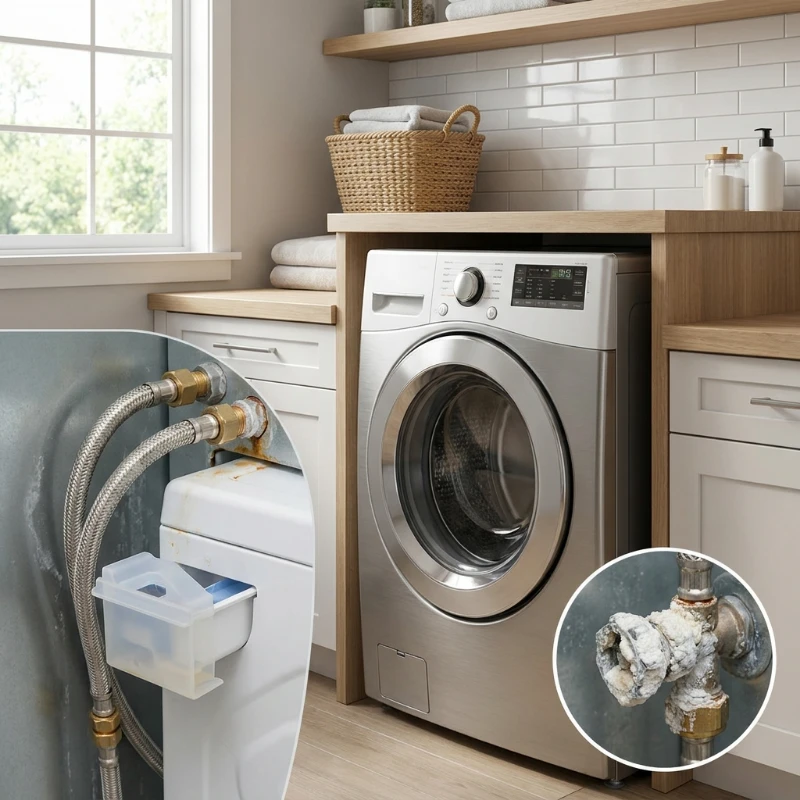
The mechanism most often cited is mineral buildup inside the water inlet valve, specifically the small mesh screens that filter incoming water before it reaches the machine. Over time, those screens can accumulate mineral deposits and restrict water flow. Independent repair sources also describe scale forming inside the drum, and in front-load machines with an internal heating element, on that element directly. Hard water can also react with laundry detergent, leaving mineral residue rather than dissolving fully.
No source reviewed for this guide establishes a specific hardness threshold for washing machine damage the way Whirlpool does for dishwashers. It’s also worth noting that inlet-valve symptoms, such as slow filling or a machine that fills with only hot or only cold water, can come from causes unrelated to hardness, including general sediment, a partially closed supply valve, or a kinked hose.
If a washer is filling slowly, filling unevenly, or not draining properly, and basic checks (supply valves, hoses, inlet screens) don’t resolve it, that’s a reasonable point to bring in a technician.
Ice makers
Hard Water and Ice Makers
Ice makers depend on a steady, unrestricted water fill, which makes them sensitive to anything that narrows or clogs the fill path, including mineral scale.
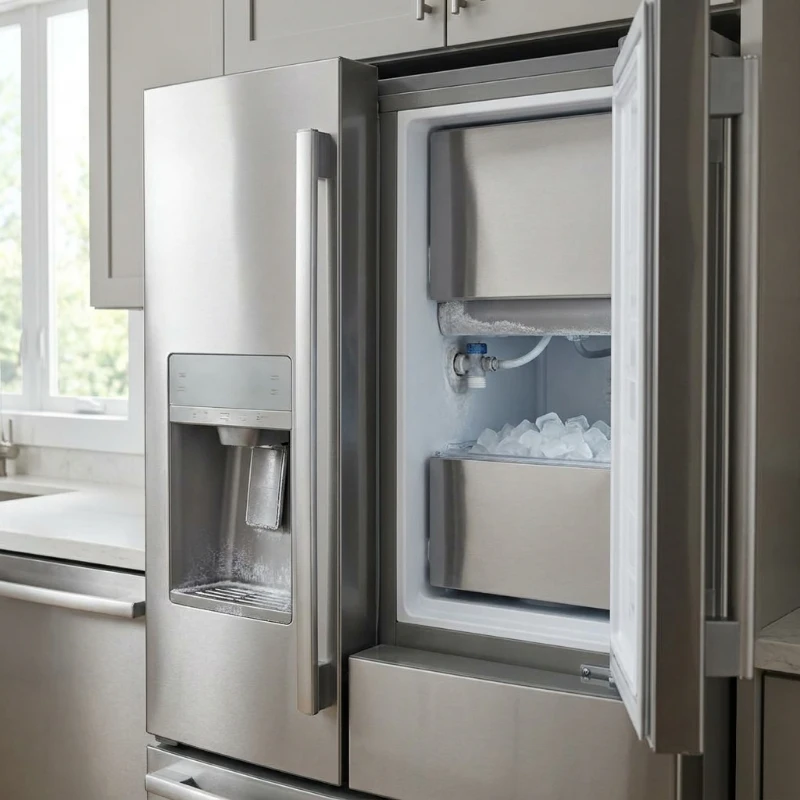
Appliance-repair sources describe scale forming in the fill valve and fill tube over time, consistent with the general scale-formation mechanism described earlier. A commonly cited early symptom is small or hollow ice cubes, which can indicate the ice maker isn’t getting a full water fill. This specific mechanism is documented mainly by independent repair sources rather than a manufacturer statement with a defined hardness threshold, so it should be treated as a plausible, moderately-supported explanation rather than a proven one.
Not every ice-maker problem traces back to hard water. Reduced ice production or small cubes can also result from a clogged water filter (a separate issue from mineral scale, covered below), a mechanical fill-valve problem, or a simple filter-replacement issue unrelated to water hardness. If an ice maker is producing small, hollow, or inconsistent ice and basic filter maintenance hasn’t helped, that’s worth a professional look.
Refrigerator water systems
Hard Water and Refrigerator Water Systems
A refrigerator’s water dispenser and ice maker typically share the same inline water filter and supply line, so many of the same mechanisms apply to both, but there’s an important nuance specific to the filter itself.
According to GE Appliances’ own support documentation, sediment in the water supply can clog a refrigerator’s water filter faster than its standard replacement interval, which can restrict flow enough to reduce dispenser output or prevent proper ice-maker filling. That’s a real, manufacturer-documented mechanism, but it’s worth being precise about what these filters actually do.
Most refrigerator water filters are carbon filters, designed primarily to reduce chlorine, taste, odor, and sediment. They are not specifically engineered to remove dissolved hardness minerals from the water. A clogged filter and hard-water scale buildup are related but distinct problems: a filter can clog from ordinary sediment with no connection to hardness at all, and dissolved calcium/magnesium can still pass through a functioning filter and later form scale elsewhere in the system, such as the fill valve.
Because of that distinction, a refrigerator water filter shouldn’t be described as a hardness solution. Following the manufacturer’s recommended filter-replacement schedule addresses flow and taste/odor issues; it doesn’t specifically prevent hard-water scale.
Signs of Mineral Buildup in an Appliance
Homeowners may notice some combination of the following:
- White or chalky deposits around a dishwasher’s spray arms or interior
- Spotting or a filmy residue on dishes and glassware after a normal cycle
- Reduced or restricted water flow to a washing machine, ice maker, or dispenser
- Small or hollow ice cubes
- A washing machine that fills slowly or fills with only hot or only cold water
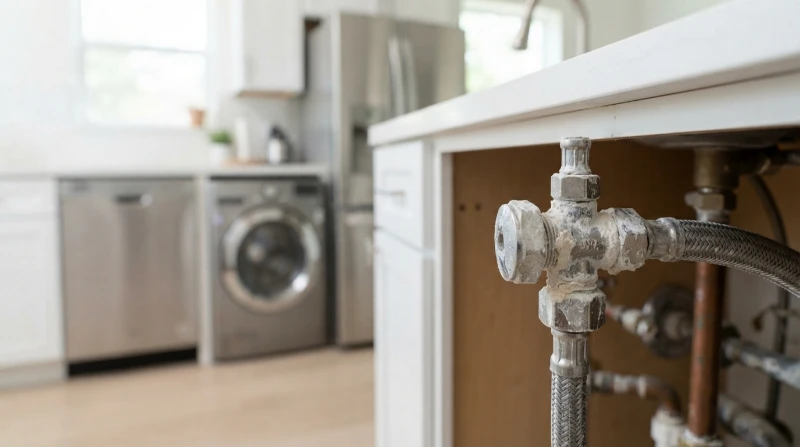
None of these symptoms is automatic proof of hard-water buildup. Each has other plausible causes:
| Symptom | Possible hard-water cause | Other possible causes |
|---|---|---|
| Reduced water flow (washer, ice maker, dispenser) | Mineral buildup in inlet screen or fill valve | Clogged filter unrelated to hardness, kinked line, partially closed supply valve, defective valve |
| Spotting/film on dishes | Calcium/magnesium reacting with detergent residue | Wrong detergent type, water temperature too low, overloaded dishwasher |
| Small/hollow ice cubes | Scale restricting the fill valve or fill tube | Clogged filter (sediment, not hardness specifically), mechanical fill-valve fault |
| Washer fills with only hot or only cold water | Mineral buildup on one inlet screen/solenoid | Electrical or mechanical valve failure unrelated to water quality |
The most reliable way to tell the difference is whether routine maintenance, such as cleaning a screen or filter, switching detergent, or checking hoses and supply valves, resolves the symptom. If it does, mineral buildup was a reasonable explanation. If it doesn’t, the cause is more likely mechanical or electrical.
Does Austin Hard Water Actually Damage Appliances?
The honest answer is not a simple yes or no. Hard water can contribute to mineral deposits and scale in water-contact equipment, but the presence of hard water does not prove that it caused a specific appliance failure.
It helps to separate three different things that get treated as interchangeable in a lot of hard-water content:
-
01Mineral buildup
The physical accumulation of scale on a surface. This is the documented, measurable effect of hard water.
-
02Appliance damage
A decline in performance or component condition that mineral buildup can contribute to over time, particularly in appliances that heat water repeatedly.
-
03Mechanical or electrical failure
A specific part breaking down. Hard water can be one contributing factor here (most clearly for water heaters, where scale has been shown to cause electric heating elements to fail periodically), but it’s rarely the sole cause, and most appliance failures involve more than one factor.
The strength of the hard-water relationship also isn’t the same across appliances. Dishwashers have the most direct, manufacturer-documented evidence, particularly for spotting and cleaning performance. Washing machines and ice makers have a plausible, consistently reported relationship, without a specific hardness threshold behind it. Refrigerator water systems have a real but partial connection through fill-valve scale, distinct from the more common filter-clogging issue. Some appliances, covered below, have little to no meaningful relationship at all.
Given that range, hard water shouldn’t be treated as the default explanation for any appliance problem in an Austin home. It’s a real, contributing factor for specific appliances and specific symptoms, not a blanket cause.
What About Ovens, Ranges, and Dryers?
It’s worth stating plainly where the hard-water connection doesn’t hold up, since a lot of consumer content connects hard water to nearly every appliance in a home.
- Standard ovens and rangesNo water-contact components, so no mechanism for hard water to affect them.
- Steam ovens and steam-assistA water reservoir and steam-generating components that can accumulate mineral deposits in hard-water areas.
- Conventional clothes dryersNo water-contact components and no meaningful established relationship with hard water.
- Steam-function dryersMineral deposits can accumulate in the steam nozzle and steam system, with periodic descaling recommended.
Standard ovens and ranges (gas or electric, including models with a self-cleaning cycle) have no water-contact components. A self-cleaning (pyrolytic) cycle works through high heat, not water, so there’s no mechanism for hard water to affect a conventional oven or range. The one exception is a steam oven or an oven with a steam-assist cooking feature, which has a water reservoir and steam-generating components that can accumulate mineral deposits in hard-water areas, consistent with the same scale-formation process described earlier. This applies specifically to models with a genuine steam function, not to ovens generally.
Conventional clothes dryers have no water-contact components and no meaningful established relationship with hard water. The exception is a steam-function dryer, which uses a water line and a fine water mist to generate steam for wrinkle-release and refresh cycles. Manufacturer and service documentation describes mineral deposits accumulating in the steam nozzle and steam system of these models in hard-water homes, with periodic descaling recommended. This applies only to dryers with a steam feature (a minority of installed units), not to standard dryers.
How to Reduce Mineral Buildup
The maintenance habits with the most direct support in manufacturer and repair documentation are appliance-specific:
- Dishwashers
Use a pre-measured detergent pod or tablet rather than powder, liquid, or gel (manufacturer testing shows better performance against filming), along with a rinse aid, and run at a wash temperature of at least 120°F.
- Washing machines
Periodically inspect and clean inlet valve screens, and check hoses for buildup or damage.
- Refrigerators / ice makers
Replace the water filter on the manufacturer’s recommended schedule, understanding that this addresses flow, taste, and odor more directly than hardness-specific scale.
- Water heaters
Periodic tank flushing is the standard response to scale accumulation.
A whole-house water softener is the general solution referenced across manufacturer and repair sources for reducing hardness-related mineral buildup across multiple appliances at once. This guide doesn’t include a specific cost, payback period, or guaranteed outcome for a softener: a water softener can reduce mineral buildup, but it isn’t a guarantee against every appliance issue, and specific savings figures weren’t consistently documented across the sources used for this guide.
When Mineral Buildup Becomes an Appliance Repair Problem
Routine mineral buildup, such as light spotting, a rinse-aid adjustment, or an occasional filter change, is normal maintenance and doesn’t call for a service visit on its own. It’s a different situation when:
- Restricted water flow persists after checking filters, screens, and supply lines
- A component isn’t functioning correctly even after basic maintenance
- Water-delivery problems (fill, drain, dispense) keep recurring
- Performance issues remain after the maintenance steps above have been tried
In those cases, mineral buildup may be one contributing factor, but it isn’t necessarily the whole explanation. A professional diagnosis is the more reliable way to separate a hard-water maintenance issue from an unrelated mechanical or electrical fault. The full list of appliance services covers what that diagnosis process looks like for each appliance type.
Frequently Asked Questions
Is Austin water hard?
Yes. Austin Water’s 2025 report puts average hardness at 93 ppm (5.4 grains per gallon), which is classified as moderately hard on the standard USGS scale, not “very hard,” a classification that starts at 180 ppm.
How hard is Austin water?
According to Austin Water’s 2025 report, hardness ranges from 70 to 126 ppm (4.1 to 7.4 grains per gallon), averaging 93 ppm (5.4 grains per gallon).
Does hard water damage appliances?
It can contribute to mineral deposits and scale-related issues in appliances that heat water or hold it in contact with certain components. It doesn’t independently prove that hard water caused a specific failure, and some appliances, like standard ovens and conventional dryers, have no meaningful relationship to hard water at all.
Which appliances are most affected by hard water?
Dishwashers and water heaters have the strongest documented evidence. Washing machines and ice makers/refrigerator water systems have a plausible but less rigorously documented relationship. Standard ovens, ranges, and conventional dryers have no meaningful established relationship.
Does hard water damage a dishwasher?
It reliably causes spotting and filming at any hardness level. Actual mechanical damage becomes a documented concern, per Whirlpool’s guidance, at 15 grains per gallon or more, well above Austin’s average and its highest reported value.
Does hard water affect a washing machine?
There’s a plausible, consistently reported mechanism involving mineral buildup in inlet valve screens and the drum, though it isn’t backed by a specific manufacturer-defined threshold the way the dishwasher connection is.
Does hard water affect an ice maker?
It can, mainly through scale in the fill valve or fill tube, though this is documented primarily by independent repair sources rather than a manufacturer statement. A clogged water filter is a separate, more common cause of ice-maker flow issues and shouldn’t be assumed to be a hardness problem.
Can hard water clog appliance water lines?
Over time, mineral scale can restrict flow in narrow passages like inlet screens and fill tubes, the same mechanism behind several of the symptoms described in this guide.
How can you tell if mineral buildup is affecting an appliance?
Check whether routine maintenance, such as cleaning a filter or screen, adjusting detergent, or checking hoses and valves, resolves the symptom. If it does, mineral buildup was a reasonable explanation; if it doesn’t, the cause is more likely mechanical or electrical.
Can hard water cause an appliance to stop working entirely?
It’s rarely the sole cause. The most direct evidence of hard water contributing to component failure involves water heaters, where scale has been shown to cause electric heating elements to fail over years of accumulation, but even there, it’s a contributing factor alongside normal wear, not a guaranteed outcome.
How can homeowners reduce mineral buildup?
Appliance-specific maintenance, including the right dishwasher detergent and rinse aid, clean inlet screens, on-schedule filter replacement, and periodic water heater flushing, addresses buildup on individual appliances. A whole-house water softener is the broader solution referenced across manufacturer and repair sources, without a guarantee against every possible issue.
When does mineral buildup require appliance service?
When restricted flow, malfunctioning components, or recurring water-delivery problems persist after basic maintenance. At that point, a professional diagnosis can determine how much of the issue is mineral-related versus a separate mechanical or electrical problem.